Key Takeaways
The states where land genuinely costs under $1,000 an acre in 2026, taken from the current USDA report, plus the ones that only look cheap.
- New Mexico is the cheapest state in the country, at $650 an acre for pasture and $735 for farm real estate.
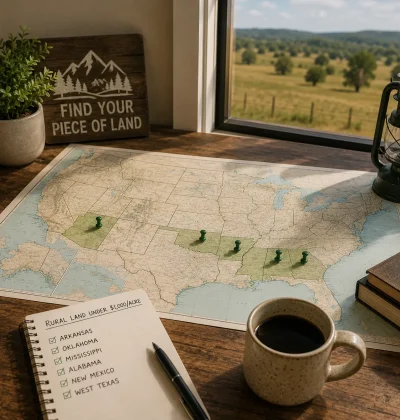
- Five states are still under $1,000 an acre for pasture: New Mexico, Wyoming, Nevada, Montana and Arizona.
- Arizona is the trap. Its rangeland is $980 an acre but its farm real estate is $4,300, nearly the national average.
- The West is cheap because it is arid, thinly populated and largely federal. The BLM alone manages 245 million acres.
- Cheap parcels are usually cheap for a reason, and access, water and flood status are the three that matter most.
The USDA published its 2026 land values on 31 July, and the gap between the cheapest state and the national average is wider than most people assume. Land in New Mexico averages $735 an acre. The national average is $4,500. That is a factor of six.
This is the list built from that report rather than from other people’s lists. It covers which states are genuinely cheapest, why, which one is cheap only on paper, and what to check before a low price per acre turns into a parcel you cannot use. If you are earlier in the process, start with our guide to how to buy vacant land.
Quick verdict: the cheapest land in America is arid western rangeland, and New Mexico leads at $650 an acre for pasture. Wyoming, Nevada, Montana and Arizona complete the sub-$1,000 group. Buy there if you want acreage and accept remoteness. Verify legal access, water and flood status first, because a $650 parcel you cannot reach or build on is not cheap, it is worthless.
Which State Has the Cheapest Land in 2026?
New Mexico, on both measures the USDA publishes.
Its pastureland averages $650 per acre and its farm real estate $735 per acre, the lowest of any state in the country. For comparison, the national averages in the same report are $2,000 for pasture and $4,500 for farm real estate.
Pasture is the better proxy for raw rural land than the farm real estate figure, which is pulled upward by irrigated cropland that most land buyers are not shopping for. Where the two figures sit close together, as they do in New Mexico, the state is cheap across the board.
It is worth knowing what those two numbers actually count. Farm real estate is the value of all land and buildings on farms, so it carries barns, irrigation infrastructure and cropland. Pasture is grazing and rangeland with none of that attached, which is much closer to what someone shopping for bare acreage is actually buying.
Neither is a listing price. Both are USDA survey averages across an entire state, which makes them a benchmark rather than a quote.
The Cheapest States to Buy Land, 2026 USDA Figures
Ranked by 2026 pasture value per acre, with the 2025 column kept so the direction is visible.
| State | Pasture 2026 | Pasture 2025 | Farm real estate 2026 | Why it is cheap |
| New Mexico | $650 | $630 | $735 | Arid rangeland, low demand throughout |
| Wyoming | $770 | $755 | $1,030 | Smallest population in the country |
| Nevada | $870 | $850 | $1,230 | Desert, and overwhelmingly federal |
| Montana | $940 | $920 | $1,260 | Remote acreage, hard winters |
| Arizona | $980 | $950 | $4,300 | Cheap rangeland only, see below |
| Oregon | $1,120 | $1,080 | – | Eastern high desert |
| Colorado | $1,200 | $1,150 | – | Eastern plains, San Luis Valley |
| United States | $2,000 | $1,920 | $4,500 | National average |
Two caveats worth knowing before you quote these numbers anywhere.
Arizona and Nevada pasture values were withheld from 2022 to 2024 and have only been published for two years, because USDA suppresses figures that would disclose data for individual operations. Their trend lines are short.
These are statewide averages, not asking prices. Remote parcels in any of these states routinely trade well below the state average, and parcels with water, power at the boundary or paved access trade well above it. Our breakdown of land value by state goes through how to read an average against a specific parcel.
Why Is Land So Cheap in the West?
Three things, and they compound.
Aridity. Rangeland in New Mexico or Nevada supports a fraction of the livestock per acre that Midwest pasture does, so its productive value per acre is genuinely lower. The price is not a market failure, it is a yield.
Federal ownership. The Bureau of Land Management manages 245 million acres, roughly one in every ten acres in the United States, and it is concentrated almost entirely in the West. Nevada alone accounts for 48 million surface acres, against just over 40,000 acres spread across 31 eastern states. Private land in these states competes against an enormous adjacent supply of open country.
Population and access. Wyoming has the smallest population of any state. Fewer buyers, longer drives, no utilities at the parcel line and no development pressure all push the per-acre number down. That is also what makes the region genuinely attractive if off-grid land is what you actually want.
Which State Is Only Cheap on Paper?
Arizona, and the USDA’s own two columns give it away.
| State | Pasture | Farm real estate | Ratio |
| New Mexico | $650 | $735 | 1.1x |
| Wyoming | $770 | $1,030 | 1.3x |
| Montana | $940 | $1,260 | 1.3x |
| Nevada | $870 | $1,230 | 1.4x |
| Arizona | $980 | $4,300 | 4.4x |
| United States | $2,000 | $4,500 | 2.3x |
Arizona’s farm real estate averages $4,300 an acre, within 5% of the national average, while its rangeland averages $980. Nothing else on this list behaves that way. Every other cheap state has land that stays cheap as it improves.
What that ratio is measuring is water. In Arizona, land with a secure water supply is priced like productive farmland anywhere in America, and land without one is priced like desert. The $980 figure is real, and it describes the parcels with no water.
New Mexico sits at the other extreme with a 13% gap between the two, which is why it tops the list on both measures rather than just one.
Why Is Cheap Land Usually Cheap for a Reason?
Because the statewide average already prices in aridity and remoteness. When a specific parcel is priced well below its own state’s average, something else is going on, and it is usually one of these.
No legal access. The parcel is landlocked with no recorded easement across the neighbouring land. There is no right to cross someone else’s property just because it is the only way in, and a parcel you cannot legally reach is close to unsellable.
No water, or no water right. In the prior appropriation states, water rights are held and transferred separately from the land. The New Mexico Office of the State Engineer notes that agreements to purchase and sell water rights are drawn up between buyer and seller, which is exactly the point: owning the ground does not hand you the water under it. Confirm the position with the state before you assume a parcel has any.
No utilities. Off-grid is a feature if you planned for it and a large unbudgeted cost if you did not. Bringing power any real distance is frequently a five-figure line item.
Flood or wetland status. Check it in minutes at the FEMA Flood Map Service Center, the official public source for flood hazard information under the National Flood Insurance Program.
Zoning, or a property owners association. Some cheap subdivided parcels cannot be built on at all, and others carry annual POA dues that quietly outrun the property tax.
A parcel with none of these is a genuine bargain. A parcel with three is the reason cheap land has the reputation it has. Our raw land due diligence checklist walks the whole sequence in order.
Run the checks cheapest first. Flood zone, county parcel maps, zoning and assessed value are all free and take an afternoon at a desk, and any one of them can kill a parcel before you have spent a dollar. Title work, a survey and a site visit come after, once the free checks have told you the parcel is worth the trip.
That order matters more at these prices than anywhere else in real estate. On a $12,000 parcel, a $2,500 survey is a fifth of the purchase price, so you want to be fairly confident before you order one.
How Do You Find Cheap Land Worth Buying?
The target is not the lowest price per acre. It is the lowest price per acre that still does what you need.
Work backwards from use. Decide first whether you need road access, a well or a building permit, then filter for parcels that clear those before you ever sort by price. Sorting by price first is how people end up owning landlocked desert.
Then compare like with like. A $600 acre in Catron County, New Mexico and a $600 acre outside Kingman, Arizona are different propositions once you look at water, and the state average will not tell you which is which. Browse real asking prices on our vacant land marketplace and check them against the state figures above rather than against another listing.
Watch how price per acre behaves across parcel sizes, because it is the number most likely to mislead you. Small parcels almost always carry a higher price per acre than large ones in the same county, since the fixed costs of a sale, the survey, the title work and the closing, are spread over fewer acres. Comparing a 5-acre lot against a 160-acre section on price per acre alone tells you almost nothing useful.
The practical version is to compare within a size band and within a county, then check that band against the state average to see whether the whole area is priced normally.
Is Cheap Land a Good Investment?
It can be, and the USDA’s own series is the argument for it. New Mexico pasture has gone from $518 an acre in 2022 to $650 in 2026, a rise of about 25% in four years. The national pasture average rose about 23% over the same period, and ERS notes that US farmland values have generally trended upward since 1950.
That is the honest version of the bull case: broad, slow appreciation on an asset with low carrying costs, not a quick flip.
The honest version of the bear case is that averages appreciate and individual bad parcels do not. A landlocked parcel with no water does not track the state average, because the pool of people who will ever buy it is close to empty. Whether is buying land a good investment applies to a specific parcel depends far more on its fundamentals than on which state it sits in. None of this is investment advice, and it is worth a conversation with a professional before committing capital.
Who Should Buy Cheap Western Land, and Who Should Not?
It suits homesteaders, off-grid buyers, hunters and recreational owners, people who want acreage more than they want services, and patient holders who will not need to sell on a deadline.
It does not suit anyone who needs utilities at the parcel line, easy year-round access, a building permit on a short timeline, or a quick resale. It also does not suit anyone unwilling to do the due diligence, because at these prices the diligence is the whole job.
If you are weighing two states or two parcels and cannot separate them, get in touch and we will go through the specifics with you.
Start From the Parcel, Not the State Ranking
State averages tell you where to look. They tell you nothing about whether the parcel in front of you is worth $650 an acre or nothing at all.
Ready to see real prices in these states? Start your free trial and compare live parcels against the USDA figures above.
Frequently Asked Questions
What is the cheapest state to buy land?
New Mexico. In the USDA’s 2026 Land Values report its pastureland averages $650 per acre and its farm real estate $735 per acre, the lowest in the nation on both measures. Wyoming, Nevada, Montana and Arizona also have pasture under $1,000. Remote parcels in any of them routinely sell for less.
Can you still buy land for under $1,000 an acre in 2026?
Yes. USDA’s 2026 figures show pasture under $1,000 per acre in five states: New Mexico at $650, Wyoming $770, Nevada $870, Montana $940 and Arizona $980. Remote parcels elsewhere also sell below that. The catch is that a low price usually reflects missing access, water or utilities you must verify.
Why is land so cheap in the western states?
Arid rangeland produces less per acre, populations are small, and the federal government owns much of the region. The BLM alone manages 245 million acres, about one in ten acres nationally, and 48 million of those are in Nevada. Low rainfall, remoteness and absent utilities push per-acre prices to the bottom of the national range.
Is Arizona actually a cheap state for land?
Only for rangeland. Arizona pasture averages $980 an acre in 2026, but its farm real estate averages $4,300, close to the $4,500 national average and 4.4 times its own pasture figure. No other cheap state shows that gap. In practice the difference is water, so verify water before treating an Arizona price as a bargain.
What should I check before buying cheap land?
Legal road access or a recorded easement, water availability and whether any water right transfers, utility distance, zoning and permitted use, and flood status via the FEMA Flood Map Service Center. Then check annual property tax and any property owners association dues. Most cheap parcels carry at least one of these limitations.
Resources and Further Reading
- USDA NASS Land Values 2026 Summary is the primary release, published 31 July 2026, and the source of every per-acre figure on this page.
- USDA Economic Research Service: Farmland Value covers the long-run trend in US farmland values since 1950.
- Bureau of Land Management: What We Manage documents the 245 million acres of federal public land that shape western land markets.
- New Mexico Office of the State Engineer: FAQs explains how water rights are administered and transacted in a prior appropriation state.
- FEMA Flood Map Service Center is the official public source for flood hazard information and lets you check a parcel by address.