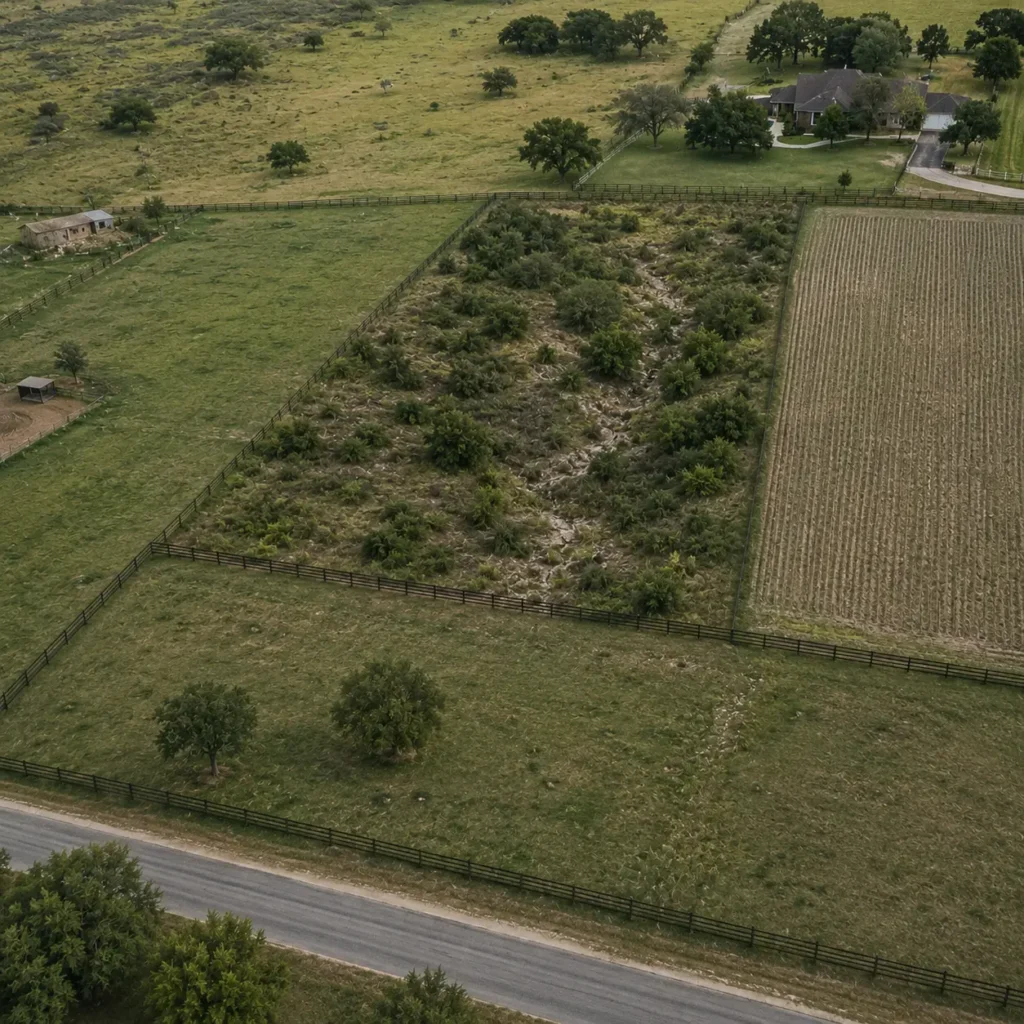
Key Takeaways
What actually creates legal access to a landlocked parcel, what federal wetland law still reaches, and who buys land with a known defect.
- An easement by necessity requires unity of ownership before severance. No historical severance means no easement, at any price.
- The traditional standard is strict necessity: the severance must have caused the parcel to be absolutely landlocked.
- If the chain of title gives you nothing, access is something you buy from a neighbour, not something you claim.
- Federal wetland jurisdiction narrowed in 2023 to waters with a continuous surface connection. State programmes may still be broader.
- A tax lien takes precedence over a mortgage, which is why no title company will close around one.
Most advice about landlocked land contains the same sentence: get an easement by necessity. It is the single most misleading thing written about this subject, because it describes a doctrine as though it were a service you can purchase.
You cannot go and get an easement by necessity. It either already exists, buried in a severance that happened decades ago, or it does not exist and never will. Which of those is true for your parcel is a question the county records answer in an afternoon.
This guide is for the owner of a parcel that will not sell: landlocked ground, wet ground, steep or unbuildable ground, or land carrying back taxes and title defects. Each one has a different fix, a different legal position and a different buyer. The general selling mechanics sit in our guide to where land buyers search, which covers pricing, photography and exposure for any parcel.
Quick verdict: every defective parcel has a buyer, and the price is set by which defect it has and whether the defect is fixable. Start with the records, not the lawyer: pull the chain of title, pull the flood map, pull the soil survey. Those three searches cost nothing and they tell you whether you are selling a fixable problem or a permanent one. Then price for the answer and market to the buyer who wants that specific kind of ground. None of this is legal or tax advice, so take the specifics to a real estate attorney in your state.
Why Is Some Land Hard to Sell?
Because a specific, nameable defect limits how the parcel can be used, financed or reached. The land is rarely the problem. The paperwork usually is.
| Problem | Why buyers hesitate | What actually helps | Likely buyer |
| Landlocked, no legal access | Cannot legally reach or build | Search the chain of title for a severance, then negotiate | Adjacent owner, investor |
| Flood zone or wetland | Building limits, insurance cost | Pull the map, check current jurisdiction, disclose | Recreational, conservation |
| No utilities or off-grid | Costly to develop | Market the use that does not need them | Homesteader, hunter |
| Back taxes or liens | Debt outranks a mortgage | Clear from proceeds at closing | Cash buyer, any buyer |
| Steep ground or poor soil | Hard to build or farm | Show the soil data, price for the real use | Recreational, timber |
| Title cloud or unclear heirs | Ownership is not marketable | Resolve before listing, often quiet title | Patient investor |
Every row splits into the same two questions. Is the defect fixable, and if not, which buyer does not care?
Can You Actually Get an Easement by Necessity?
Only if your parcel and a neighbouring one were once a single tract under one owner, and the split is what landlocked you. Otherwise the doctrine does not apply to your land at all.
Cornell’s Legal Information Institute sets out the two elements of an implied easement by necessity: “(1) unity of ownership prior to separation, meaning both estates were once owned as a single unit or tract and (2) necessity for the easement at the time of severance.”
Both halves matter. Unity of ownership is a fact about the chain of title, not about geography. And the necessity has to have existed at the moment of severance, not today. A parcel that had road frontage in 1974 and lost it when a highway realignment took the frontage in 2003 has a different problem, and a different remedy.
How much necessity is required depends on your state. The traditional rule demands strict necessity: “The owner of the landlocked property must prove that the severance of title caused the property to be absolutely landlocked.” A minority of states accept reasonable necessity, where “There can be no other reasonable way of enjoying the property without the easement; it requires more than mere convenience.”
So the first thing to do is not to call an attorney. It is to order a chain of title from the county recorder or a title company and look for the severance. If you find one, you have something to take to a lawyer. If the two parcels were never one, you do not, and the next section is your route instead.
What If the Chain of Title Gives You Nothing?
Then access is something you buy, not something you claim. That is a very different negotiation and it belongs in your listing strategy rather than your legal budget.
A negotiated access easement is a purchase from the neighbour, recorded so that it runs with the land and transfers to your buyer. The neighbour has no obligation to sell it and knows exactly how much leverage they hold, which is why this often ends with the neighbour buying the parcel instead. That is not a failure. The adjacent owner is the natural buyer for a landlocked tract precisely because they already have the access that makes it usable.
Two other routes exist and both are narrow. A prescriptive easement can arise from long, open, continuous use without permission, on a timetable set by state statute. And a number of states have statutory ways of necessity or private condemnation procedures that let a landlocked owner petition for access, with compensation to the neighbour. Whether either is available where your parcel sits is genuinely state-specific and worth one paid hour with a local real estate attorney.
Whatever route you take, get the result recorded. An informal understanding with the neighbour is worth nothing to a buyer, and a title company will not insure around it.
Does Federal Wetland Law Still Reach Your Parcel?
Maybe not, and that is a change from how most articles still describe it. Federal jurisdiction over wetlands narrowed substantially in 2023.
Following the Supreme Court’s decision in Sackett, the agencies amended the regulatory definition of waters of the United States. The EPA’s own fact sheet on the amended rule describes removing “the significant nexus standard” and revising the definition of adjacent to mean “having a continuous surface connection.”
In practice that means a wet area with no continuous surface connection to a jurisdictional water may now sit outside the federal permitting regime that would previously have captured it. For a seller, that can be the difference between a parcel a builder rejects and one they will consider.
Read the caveat carefully though, because it is the part that gets people in trouble. Federal jurisdiction narrowing does not repeal state law, and several states run wetland programmes that are broader than the federal one. It also does not change the flood picture, which is a separate question with its own map. Pull your parcel on the FEMA Map Service Center and disclose what it says, because every serious buyer checks it during due diligence anyway.
How Do Back Taxes and Liens Actually Clear?
From your sale proceeds at closing, and the reason the title company insists on it is priority. Cornell’s Legal Information Institute defines a tax lien as “a lien acquired by court order that gives the government a security interest in property because of a failure to pay assessed taxes”, and notes that “If the property is mortgaged a tax lien will take precedence over the mortgage.”
That single sentence explains the whole dynamic. A tax lien outranks the lender, so a buyer’s lender will not fund and a title company will not insure until it is gone. It is not an obstacle to selling, it is a line on the settlement statement.
What does stop a sale is finding out late. Order a title search before you list rather than after you are under contract, so that liens, old easements, missing heirs and boundary conflicts surface while there is still time. Our buyer-side checklist treats Confirm clear title as step one for exactly this reason, and a seller who has already done it closes faster than one who has not.
Title clouds from inheritance or defective old deeds are a different order of problem and often need a quiet title action. That is attorney territory, it takes months, and it is worth starting before the parcel goes on the market rather than during a buyer’s contingency window.
What About Poor Soil, Steep Ground or No Utilities?
Match the parcel to a use that does not need what it lacks, and show the data rather than avoiding it.
Ground that fails a percolation test for septic can still be excellent for hunting, timber or seasonal camping. Steep ground that will not take a house may carry merchantable timber. The buyer for each of those is real and is not deterred by the thing that scared off the last three.
Give them the evidence up front. The USDA’s Web Soil Survey publishes soil types and limitation ratings including septic suitability, with data online for “more than 95 percent of the nation’s counties.” Linking a buyer straight to their own answer converts far better than a vague reassurance, and it filters out the buyers who were going to walk at the perc test anyway.
Off-grid parcels are the clearest case of all. Homesteaders, hunters and preppers actively want remote unimproved ground, so lead with the acreage, the privacy and the access, not with an apology about the missing power line.
Who Actually Buys Problem Land?
Three groups, and they price on potential rather than on condition: cash investors, adjacent landowners, and use-specific buyers who want exactly the thing everyone else rejects.
Cash investors are usually the fastest route because they are not waiting on a lender who would decline the parcel anyway. They apply a discount for the defect and for speed, and both are negotiable. Our guide to how to Find your own cash buyer covers where they gather and how to check one is real before you sign anything.
The adjacent owner deserves a direct approach rather than a listing. On a landlocked parcel they are frequently the only buyer for whom the defect does not exist, and a letter to the three neighbours whose land touches yours costs the price of three stamps.
Owner financing widens the pool further, because it removes the bank that would have rejected the parcel on sight. When the buyer makes a down payment and pays you over time, a lender’s opinion of your access easement stops being the deciding factor. The trade is that you wait for the money and carry the default risk, so structure it with an attorney.
How Do You Price a Parcel With a Known Defect?
At what a buyer who can solve the defect would actually pay, which is not the clean-comparable price minus a token discount.
Start from sales of similarly defective parcels where you can find them, then reason from the cost of the fix. If an access easement is genuinely obtainable and a neighbour has quoted a number, that number is your discount floor. If it is not obtainable, you are pricing a recreational or adjacent-owner parcel and the comparable set changes entirely.
The failure mode is the one that costs the most and looks the safest, which is holding the price and waiting. Overpricing on hope is what leaves difficult parcels sitting for years while the owner keeps paying taxes on ground nobody is looking at.
When the price reflects the problem openly, the listing does a second job: it signals to buyers that you already know what you own and are ready to transact. That filters your inquiries down to people who can actually close.
What Do Sellers Get Wrong?
Hiding the defect, and treating a legal doctrine as a purchasing decision. In order of cost:
- Assuming an easement by necessity is available. Without unity of ownership before severance, it is not, and months get spent finding that out.
- Concealing flood, access or title problems. Buyers find all three in due diligence, and concealment turns a slow sale into a lawsuit.
- Listing before ordering a title search, then discovering heirs or liens during a buyer’s contingency window.
- Advertising a landlocked tract as a homesite. It attracts nobody and wastes the listing.
- Refusing owner financing on a parcel no bank will touch.
- Never contacting the neighbours, who are often the only buyers for whom the defect is not a defect.
Should You Sell It, or Let It Go?
Sell it. A discounted sale beats paying taxes indefinitely on ground you cannot use, and letting a parcel go to tax default destroys value you could have captured with three records searches and a letter to a neighbour.
Name the defect, find out from the chain of title whether it is fixable, disclose it either way, and price for the buyer who wants that exact kind of parcel. Difficult land does move. It moves on terms, not on patience.
If you want the listing seen by the buyers who work this end of the market, the seller tools let you Connect directly with verified buyers rather than waiting for a retail buyer who was never coming.
List your parcel with the defect stated and you will spend your time on the people who have already accepted it.
Frequently Asked Questions
Can you sell landlocked land?
Yes, and the price depends on whether legal access is obtainable. Check the chain of title first: an easement by necessity requires that your parcel and a neighbouring one were once a single tract, and that the split caused the landlock. If no such severance exists, access must be negotiated and purchased, and the adjacent owner becomes your most realistic buyer.
What are the requirements for an easement by necessity?
Two. Unity of ownership before separation, meaning both parcels were once owned as one tract, and necessity for the easement at the time of severance. Most states apply a strict necessity standard, requiring proof that the severance left the parcel absolutely landlocked. A minority accept reasonable necessity, which still demands more than mere convenience.
Do I have to disclose that land is in a flood zone?
Disclose known flood, wetland, access and title issues in writing. Many states require it, and buyers verify flood status on FEMA maps during due diligence regardless. Concealing a known defect turns a manageable price negotiation into a post-closing claim, and serious buyers treat open disclosure as evidence that the rest of your file is reliable.
Who buys land with back taxes or liens?
Cash investors and experienced land buyers, because the debt clears from sale proceeds at closing. A tax lien takes precedence over a mortgage, so a lender will not fund and a title company will not insure until it is paid. Order a title search before listing so every encumbrance surfaces while there is still time to plan for it.
Does federal law still regulate wetlands on my land?
Sometimes. After the 2023 amendments following Sackett, federal jurisdiction reaches wetlands with a continuous surface connection to a jurisdictional water, and the significant nexus standard was removed. Many states run broader programmes of their own, so a parcel outside federal jurisdiction may still be regulated locally. Confirm with your state environmental agency.
Resources and Further Reading
- Cornell LII, implied easement by necessity The two required elements and the strict versus reasonable necessity standards.
- Cornell LII, tax lien What a tax lien is and why it takes precedence over a mortgage.
- EPA fact sheet, amendments to the definition of waters of the United States The post-Sackett continuous surface connection test for wetlands.
- FEMA Map Service Center Official flood maps for confirming special flood hazard area status.
- USDA Web Soil Survey Free soil and septic limitation data covering more than 95 percent of US counties.