Key Takeaways
What an easement on property is, why sources disagree on how many types exist, and which ones land buyers meet in a title commitment.
- An easement is a right in someone else’s land, and an appurtenant one transfers with the parcel whether or not anyone mentions it
- California’s statute enumerates eighteen appurtenant easements and Montana’s enumerates twenty, which is why the count varies by source
- The two questions that matter are who holds it and how it was created, not which label a blog post puts on it
- Easements can impose affirmative duties, including fence maintenance and undisturbed water flow, not only a right to cross
- A conservation easement is the one kind that restricts what the owner may do, and its holder is a government body or a charity
An easement on property is a right to use land that somebody else owns. The holder does not own the ground and cannot exclude the owner. What the holder has is a defined right to do one specific thing on it, and that right can outlast everyone involved in creating it.
Search for the types and you get a mess. One page says three. The next says four. A third says five. None says why the number moves, and the answer is that the number is not a legal fact.
This post uses the text of four state statutes rather than a summary, because the statutes are where the lists live. It is information, not legal advice. What burdens your parcel is answered by its recorded chain of title and your state’s own code, which is work for a real estate attorney licensed where the land sits.
Quick verdict: Do not memorize a number. Ask two questions about any easement you find: who holds it, and how was it created. Those two answers tell you whether it transfers, whether it can be moved, and whether it can be ended.
What is an easement on property?
An easement is a right to use land you do not own, for a stated purpose. California’s statute reaches the definition from the other direction, by listing the burdens themselves: the ones that “may be attached to other land as incidents or appurtenances,” it says, “are then called easements.”
That phrasing carries the fact buyers miss. An appurtenance attaches to a parcel, not a person. When the parcel sells the easement goes with it, and nobody has to mention it at closing. Deeded access, a utility corridor, a drainage channel: all of it travels.
The holder’s rights are narrow and the owner keeps everything else. California Civil Code 801 lists eighteen of these, from “the right-of-way” to “the right of flooding land” to “the right of a seat in church.” A right to cross is one entry on a long list.
An easement is also not a lease and not a license. A lease gives possession; a license is permission the owner can revoke. An easement is an interest in the land itself, which is why it survives a sale. Access and title belong near the front of any land purchase, which is why the guide to what to look for when buying land puts them ahead of the site visit.
Why do sources give different numbers of easement types?
Because the states enumerate different lists, and the pages ranking for this question are counting different things. The page titles on that results page say three, four and five.
California Civil Code 801 enumerates eighteen appurtenant servitudes. Montana Code Annotated 70-17-101 opens with almost the same sentence, that these burdens “may be attached to other land as incidents or appurtenances” and “are then called easements,” and then enumerates twenty. Same opening words, two more entries.
The two Montana adds are worth knowing. Item 18 is “the right of conserving open space to preserve park, recreational, historic, aesthetic, cultural, and natural values on or related to land,” which puts conservation inside the enumerated list. Item 20 is “the right of using land adjacent to a firearms shooting range as a range safety zone,” which matters if you are buying acreage near a range.
So the count moves because the statute moves. A page that says there are four types is describing a grouping invented for readability, not a list you can check your parcel against. The list you can check is your state’s code plus the instrument recorded against your title.
What is the difference between an appurtenant easement and an easement in gross?
Who holds it. An appurtenant easement is held by a neighboring parcel. An easement in gross is held by a person or a company, with no parcel attached.
The statutes draw this line explicitly. Civil Code 801 covers burdens that “may be attached to other land as incidents or appurtenances.” California Civil Code 802 covers the ones that “may be granted and held, though not attached to land,” and that list runs to six items: pasture and fishing and taking game, a seat in church, burial, “the right of taking rents and tolls,” right of way, and taking water, wood, minerals or other things.
Notice how short the second list is. Eighteen against six. A utility’s corridor is an in-gross right: the company holds it and no neighboring parcel does.
The consequence at closing is concrete. An appurtenant easement moves with the land, so benefit and burden both change hands without a new document. An easement in gross stays with its holder, so the company keeps its corridor and you inherit the obligation. Read the instrument to see which you have.
Which easements do land buyers actually run into?
Six, in practice, and they cut across both of the statutory axes rather than sitting neatly inside either.
Access, which the statutes list as “the right-of-way.” Utility and pipeline corridors, held in gross by a company. Drainage and flowage, which the enumerated lists cover three separate ways: receiving or discharging water, “the right of flooding land,” and “the right of having water flow without diminution or disturbance of any kind.” Conservation, which restricts rather than permits. Prescriptive, claimed through long use. And by necessity, created by a court when a parcel would otherwise have no legal access.
Those six are a reading list, not a taxonomy. Each is a different combination of who holds it and how it arose, and those two variables decide what you can do about it.
On rural acreage the mix skews toward the first three, because corridors and water follow terrain rather than lot lines. The diligence sequence is in the guide to buying rural land.
What can an easement actually require, beyond letting someone cross?
Affirmative work, and sometimes work by the burdened owner rather than the holder. The enumerated lists make this plain.
Three entries do it directly. “The right of having the whole of a division fence maintained by a coterminous owner” puts the duty to maintain a shared fence, all of it, on the coterminous owner. “The right of receiving more than natural support from adjacent land or things affixed thereto” is a right to support beyond what the ground naturally gives, which constrains excavation next door. And “the right of having water flow without diminution or disturbance of any kind” is a prohibition on the burdened owner, not a permission for the holder.
Montana adds a modern pair in the same register: the right of receiving sunlight or wind “for recognized nonfossil forms of energy generation,” and the shooting range safety zone. California’s item 18 covers sunlight by cross-reference to its Section 801.5.
The lesson is to stop reading the label and read the grant. Two instruments both titled “easement” can impose opposite duties, and the one that obliges you to do something is the one with a recurring cost.
How is a conservation easement different from the rest?
It restricts the owner instead of admitting a user, and its holder is an institution rather than a neighbor. It is the one type here that limits what you may do with land you own outright.
Minnesota Statutes 84C.01 defines it as “a nonpossessory interest of a holder in real property imposing limitations or affirmative obligations” whose purposes include “retaining or protecting natural, scenic, or open-space values of real property,” assuring availability “for agricultural, forest, recreational, or open-space use,” protecting natural resources, maintaining air or water quality, or preserving historical, architectural, archaeological or cultural aspects.
The holder cannot be anyone. The statute limits it to “a governmental body empowered to hold an interest in real property” or “a charitable corporation, charitable association, or charitable trust” whose purposes match that list. You are dealing with a land trust or an agency, not a neighbor.
Duration is the question to ask, and the definition does not answer it. How long the limitations run is set by the recorded instrument and the state’s conservation easement act, so read both. A parcel constrained this way is a different marketing problem, which the guide to sell problem land covers.
Can someone gain an easement just by using your land?
In some states, through long use, and the bar is higher than the folklore suggests. The statutes that govern long-use claims set hard conditions, not a vibe about neighborly habit.
California’s adverse possession statute shows the shape of it. For a claim “not founded upon a written instrument, judgment, or decree,” Code of Civil Procedure 325 deems land possessed only where “it has been protected by a substantial enclosure” or “it has been usually cultivated or improved.” It then requires that the land “has been occupied and claimed for the period of five years continuously,” with all state, county and municipal taxes “timely paid,” proven by “certified records of the county tax collector.”
That statute governs claims to ownership, which is the distinction that matters. A prescriptive easement claims a right to use, not title, so the elements differ. Each state sets its own test and period.
Which is why this post states no number. If a neighbor has been crossing or draining your parcel for years, the question is specific to your state and your facts.
How do you find the easements on a parcel before you buy?
In the title commitment, under the exceptions. That is the document that lists what the title company will not insure against, and recorded easements live there by name and recording reference.
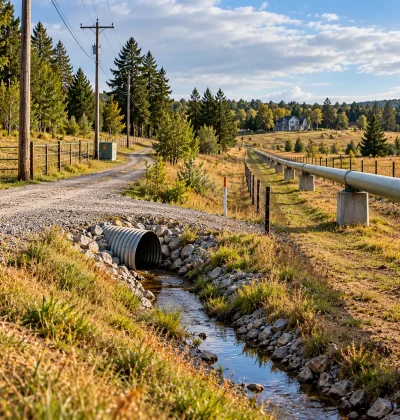
Work outward from it. Pull every instrument the commitment cites and read the grant rather than the one-line summary. Compare the described location against the survey or plat, because an easement described in a 1962 deed may not sit where anyone assumes. Then walk the ground for what paper misses: a worn track, a pedestal, a culvert, a mown strip.
Unrecorded rights are the gap. Prescriptive claims and easements by necessity arise by operation of law, so no document created them and no title search will surface them. They appear in disputes, not in commitments.
Get the findings into the contract. A purchase agreement that names the easements of record and conditions closing on your review of them turns a surprise into a contingency, and the mechanics of that document are covered in the guide to the land purchase agreement.
How does an easement affect value and what you can build?
It depends on where the burdened area sits, and that is a measurement question rather than a matter of opinion. The same easement can be irrelevant on one parcel and disqualifying on the next.
Run the overlap. Put the easement’s described width and location against the parcel’s buildable envelope, setbacks included. A utility corridor along a back fence line on forty acres changes little. The same corridor through the only level building site changes everything, and no price adjustment fixes geometry.
Then read the restrictions rather than counting acres. A conservation easement’s limitations can bar the structure you intended on ground that is otherwise perfect. Whether any of this issues a building permit is a county question, answered by local zoning and driveway standards.
Because the effect is parcel specific, treat any general rule about easements and land value with suspicion. What moves land value either way is the subject of the guide to whether buying land a good investment really is.
What should you check before buying land with an easement?
Work the two axes first, because they determine the answers that follow.
- Identify who holds it. Appurtenant, held by a neighboring parcel, or in gross, held by a person or company. Appurtenant rights transfer with the land; in gross rights stay with the holder.
- Identify how it was created. An express recorded grant, a court order, or a claim by long use. Created by operation of law means no document exists to read.
- Read the grant, not the label. Check whether it imposes affirmative duties on you, such as fence maintenance or undisturbed water flow.
- Map the burdened area against the buildable area. Width, location and setbacks together, not acreage.
- Ask about duration. For a conservation easement, the instrument and the state’s act set how long the limitations run.
- Pull your own state’s enumerated list. California lists eighteen appurtenant servitudes and Montana twenty, so your easement’s category is a question of local code.
- Get a licensed opinion before the contingency expires. Only your parcel’s recorded chain answers the question.
Do that before the offer. How to structure the contingency so the title review happens while you still have an exit is in the guide to make an offer on vacant land.
Check a parcel’s access and title picture before you commit
Frequently Asked Questions
How many types of easements are there?
There is no single number, which is why sources disagree. California Civil Code 801 enumerates eighteen appurtenant servitudes and Montana Code Annotated 70-17-101 enumerates twenty, while California Civil Code 802 lists six that are held in gross. The controlling list is your own state’s code plus the recorded instrument.
Does an easement transfer when land is sold?
An appurtenant easement does, automatically, because it attaches to the parcel rather than to a person. California Civil Code 801 describes these burdens as attached to other land “as incidents or appurtenances.” An easement in gross stays with its holder, so a utility keeps its corridor and the new owner inherits the burden.
Can a property owner remove an easement?
Not unilaterally. A recorded easement is an interest in the land held by someone else, so ending it takes the holder’s agreement, a release, or a court. This differs from a license, which is revocable permission. Ask a real estate attorney in your state what release or termination options apply to your specific instrument.
What is the difference between an easement and a right of way?
A right of way is one kind of easement, not a separate thing. Both California Civil Code 801 and Montana Code Annotated 70-17-101 list “the right-of-way” as a single numbered entry among eighteen and twenty enumerated burdens. Treating the two words as opposites is a widespread error.
Who is responsible for maintaining an easement?
It depends on the instrument and the state, and the enumerated lists show maintenance can run either way. One entry on both state lists is “the right of having the whole of a division fence maintained by a coterminous owner,” which obliges the burdened owner rather than the holder. Read the recorded grant first.
Resources and Further Reading
- California Civil Code 801 2025 edition. The enumerated list of appurtenant servitudes: eighteen numbered burdens that “may be attached to other land as incidents or appurtenances” and “are then called easements.”
- California Civil Code 802 2025 edition. The much shorter companion list of servitudes that “may be granted and held, though not attached to land,” which is the statutory definition of an easement in gross.
- Montana Code Annotated 70-17-101 2025 edition. Nearly the same opening sentence as the California section, then twenty items instead of eighteen, including conservation of open space and a firearms range safety zone.
- Minnesota Statutes 84C.01 2025 edition. Defines a conservation easement as a nonpossessory interest of a holder imposing limitations or affirmative obligations, and restricts who may hold one.
- California Code of Civil Procedure 325 2025 edition. The conditions for a long-use claim to ownership: a substantial enclosure or cultivation and improvement, five continuous years, and timely payment of all taxes.