Key Takeaways
Federal payment data, clearing methods, debris costs and the wetland permit rule every raw land buyer should check before signing.
- West Virginia’s FY2026 federal payment schedule prices one clearing practice from $27.55 to $1,195.98 an acre, a 43-fold spread in one state in one year.
- Debris disposal is a separate line worth $137.80 to $2,440.48 an acre and is the cost most buyers leave out of the budget entirely.
- Jobs of one acre or less carry roughly five times the per-acre mechanical rate of larger jobs, because mobilization is spread across fewer acres.
- The Clean Water Act farming exemption does not cover a buyer clearing raw land for a house, because that is a new use of the site.
- Clearing a wetland for agricultural production can end eligibility for USDA programs including EQIP, CRP and federal crop insurance premium support.
Most quotes you will read for land clearing come with no source attached. A contractor blog says $1,500 to $3,000 an acre, another says $500 to $1,500, and neither shows where the figure came from. That is a problem when the number sits between you and a purchase decision on a parcel you have not yet closed on.
There is better data. The USDA Natural Resources Conservation Service publishes annual payment schedules that price conservation practices line by line, by state, built from that state’s current material and labor costs. Those schedules are public, dated, and specific enough to show exactly which variables move the number and by how much. This post uses them.
Written for someone evaluating raw acreage before closing, or an owner deciding whether to clear before listing. It covers what drives the cost, what gets billed separately, and the federal permit question that catches buyers after the work is already done. None of this is legal or tax advice, and a wetland determination in particular is something to put in front of an attorney or a qualified consultant before a machine touches the ground.
Quick verdict: budget $300 to $800 an acre for ordinary wooded acreage with light stump work, add a separate debris line, and get a wetland determination before you sign anything. The permit question costs more than the clearing when it goes wrong.
What does land clearing cost per acre?
Land clearing costs $27 to $1,196 per acre depending on vegetation density, treatment method and parcel size. That range is not a guess. It is the FY2026 West Virginia payment schedule for a single NRCS conservation practice, Brush Management, code 314, with eleven separate line items priced by treatment scenario.
Here is the framing before the numbers. A payment schedule is what the federal government pays toward a practice under a cost-share contract, not a contractor invoice. Rates are built from state labor and material costs and reviewed annually, so they track market conditions closely, but a private quote can land above or below them. Treat them as a calibrated reference, not a price list. Clearing cost then feeds straight into what your land is worth, because a buyer prices the work the parcel still needs.
What makes them more useful than any contractor range is that they isolate one variable at a time. Same state, same year, same practice. Everything that changes between the lines is the work itself.
Why does the same acre cost 40 times more on one parcel than another?
Because “clearing” describes at least six different jobs, and the federal schedule prices each one separately. The full FY2026 West Virginia range for Brush Management runs from $27.55 to $1,195.98 an acre.
| Treatment scenario, NRCS practice 314 | Rate per acre |
| Chemical control, aerial application | $27.55 |
| Chemical control, individual plant treatment | $76.51 |
| Mechanical control, small shrubs, medium infestation | $77.52 |
| Mechanical and chemical, small shrubs, medium infestation | $98.63 |
| Chemical control, ground application | $110.10 |
| Split method | $128.70 |
| Mechanical control, hand application | $175.86 |
| Mechanical control, large shrubs, medium infestation | $303.81 |
| Mechanical control, one acre or less | $398.10 |
| Biological control, low density | $597.99 |
| Biological control, high density | $1,195.98 |
Read the middle of that table rather than the ends. Small shrubs at medium infestation cost $77.52 an acre mechanically. Large shrubs at the same infestation level cost $303.81. Nothing changed except the size of what is being cut, and the price went up 3.9 times. That single comparison explains more about your quote than any regional average will.
How much does the clearing method change the price?
Method changes the number by roughly 14 times at the extremes, and the cheapest option is rarely available on raw land. Aerial chemical application at $27.55 an acre is priced for broad rangeland infestations, not for a two-acre building site with neighbours.
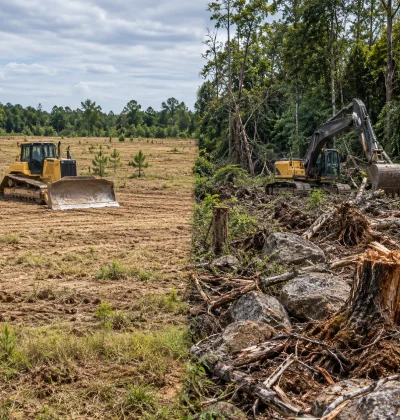
Mechanical treatment is what most buyers actually need, and it sits between $77.52 and $398.10 an acre in the same schedule. Forestry mulching, dozer work and hand clearing all fall inside that band depending on stem size and terrain. Chemical and mechanical together, at $98.63, often beats either alone on regrowth-prone species, because cutting alone invites the brush back within two seasons.
The trade-off nobody quotes on is time. Chemical control is cheap per acre and slow, sometimes a full growing season before the site is usable. Mechanical is expensive and immediate. If you are buying to build this year, the cheap line in that table is not open to you, and any comparison of quotes needs to hold the timeline constant or it is not a comparison.
What does debris disposal cost, and why is it billed separately?
Debris disposal runs $137.80 to $2,440.48 an acre and is a separate practice with its own code. NRCS prices it as practice 384, Woody Residue Treatment, and the range depends on slash volume and disposal method. That is a 17.7-fold spread on the step that happens after the clearing is finished.
This is the single most common gap in a land clearing budget. You cut the material, and then you still own it. Burning may need a permit and a burn window. Chipping needs equipment on site. Hauling needs trucks and a tipping fee. Leaving windrows on the property is cheapest and may breach a county ordinance or your own later building plans.
On a heavily wooded parcel the disposal line can exceed the clearing line. When a quote looks unusually low, ask what happens to the material. That answer is usually where the difference went.
Why do small parcels cost more per acre than large ones?
Because mobilization is a fixed cost spread over a variable number of acres. The West Virginia schedule makes this explicit: mechanical control on one acre or less is priced at $398.10, while mechanical control for small shrubs at medium infestation runs $77.52. That is 5.1 times the rate for the same category of work.
Moving a mulcher or dozer to a site, offloading it, and taking it away again costs the same whether it clears one acre or twenty. On a one-acre job that cost has nowhere to go but into the per-acre rate.
Practical consequence for buyers comparing parcels: per-acre clearing quotes are not portable between properties of different sizes. A $400 an acre figure from a neighbour’s ten-acre job tells you very little about your two-acre lot, and the same logic runs through everything else that shapes value, which is why what factors affect land value is worth reading alongside any clearing estimate.
Do you need a federal permit before clearing?
Sometimes, and the exemption most buyers rely on does not apply to them. Section 404 of the Clean Water Act requires a permit before dredged or fill material is discharged into waters of the United States, wetlands included. Most people stop reading at the exemption list.
That list is real. Under 33 CFR 323.4(a)(1)(i), “normal farming, silviculture and ranching activities such as plowing, seeding, cultivating, minor drainage, and harvesting” are exempt. EPA publishes the same list of exempt activities in plain language.
Now read the next paragraph of the regulation, which almost nobody quotes. Under 33 CFR 323.4(c), a discharge otherwise covered by those exemptions “must have a permit if it is part of an activity whose purpose is to convert an area of the waters of the United States into a use to which it was not previously subject, where the flow or circulation of waters of the United States may be impaired or the reach of such waters reduced.”
Read that against what a land buyer is actually doing. Clearing raw ground to build a house, cut a pasture, or put in a driveway is a new use of that ground. The farming exemption is written for someone continuing an established operation, not for someone starting one. If any part of the parcel is a regulated wetland, the exemption a buyer assumes protects them is the exemption that does not reach them.
What happens if you clear a regulated wetland without one?
The liability is federal, it is expensive, and it does not stop at a fine. EPA and the Army Corps of Engineers share enforcement authority over unpermitted discharges.
Under Clean Water Act Section 309(a), EPA can order the work stopped and the site restored. Section 309(g) authorizes administrative civil penalties of up to $16,000 per day of violation, capped at $187,500. Sections 309(b), 309(d) and 404(s) allow civil judicial action seeking restoration, injunctive relief and further penalties. Section 309(c) provides criminal authority for knowing or negligent violations, which EPA states is reserved for the most flagrant cases, and in United States v. Lucas produced prison sentences.
The restoration order is usually the worse outcome. Undoing clearing on a converted wetland can cost a multiple of what the clearing cost, and it leaves you with a parcel you still cannot use. This belongs on the same page as every other pre-purchase check, and the raw land due diligence checklist is where a wetland determination should sit in your sequence, before the offer rather than after it.
Can clearing cost you USDA program eligibility?
Yes, and this is the second gate most buyers never see. Under 16 USC 3821, converting a wetland by draining, dredging, filling or leveling for the purpose of making agricultural production possible makes a person ineligible for a list of USDA benefits.
That list includes production payments and marketing assistance loans, loans under the Consolidated Farm and Rural Development Act, Environmental Quality Incentives Program payments, Conservation Reserve Program payments, disaster assistance, and Federal Crop Insurance Corporation premium subsidy.
The irony is worth stating plainly. EQIP is one of the programs that would have paid part of your clearing cost under a conservation contract. Clearing the wrong ground first can remove access to the funding that would have covered clearing the right ground. Rules on prior converted cropland and mitigation are genuinely complicated and state-specific, so this is a question for a consultant and your local NRCS office rather than a blog post.
How should you budget clearing before you close?
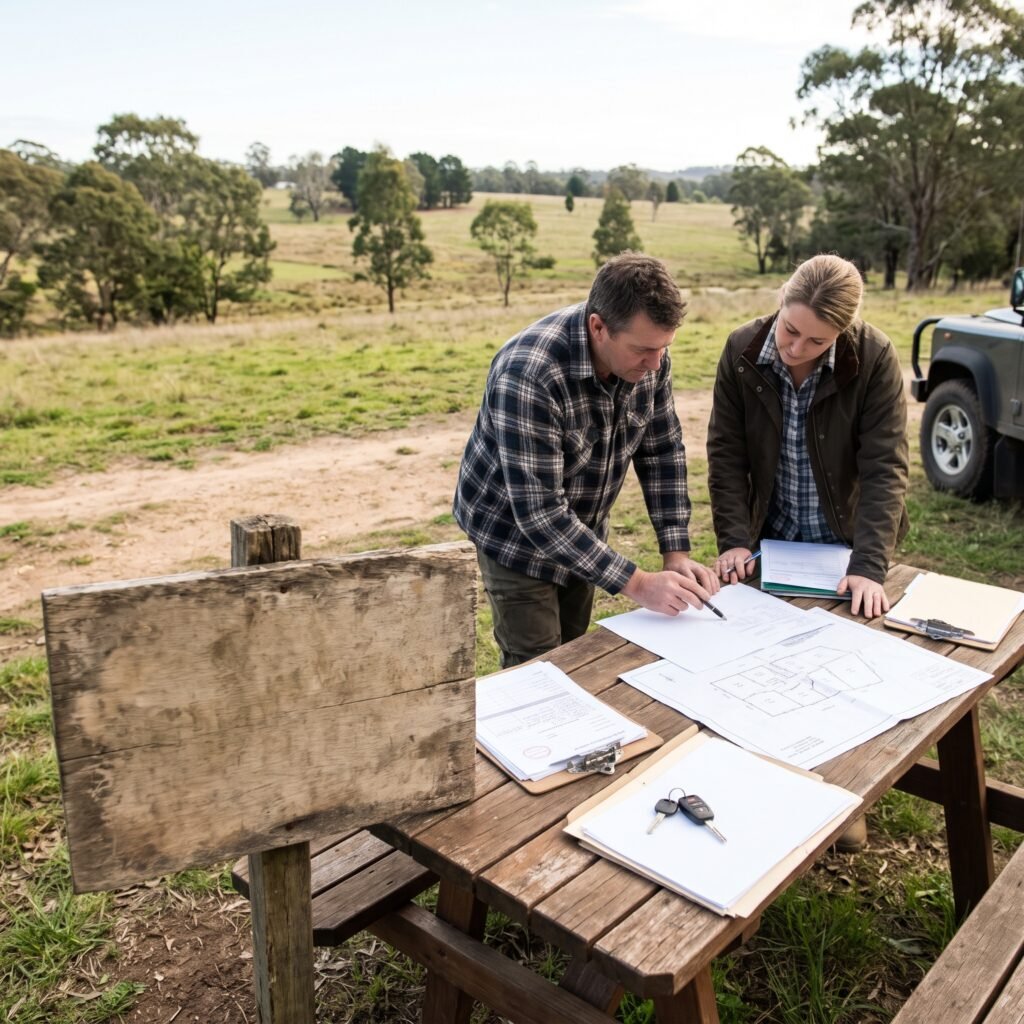
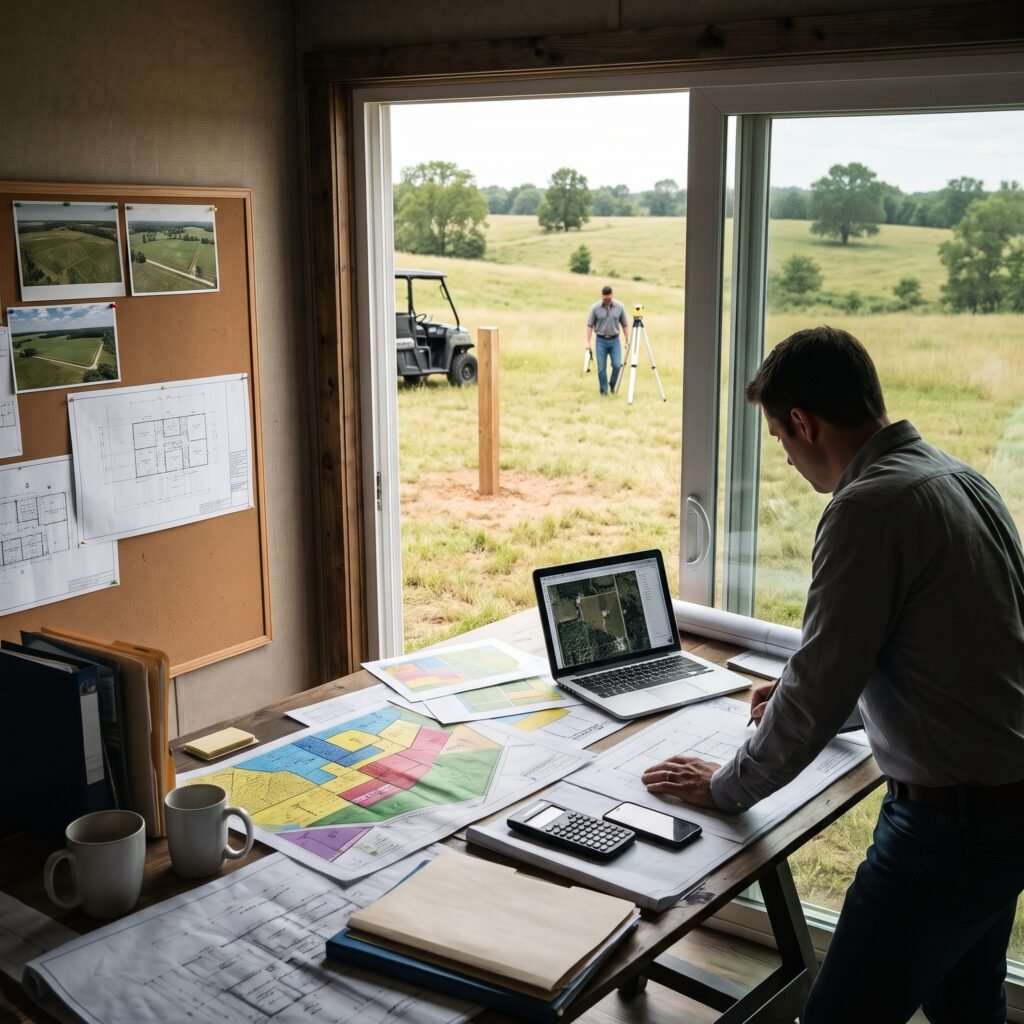
Work from the parcel, not from an average. Three numbers get you close enough to make an offer, and all three are gettable before closing.
First, acreage that actually needs clearing, which is usually far less than total acreage. A building envelope, a driveway run and a septic field on twenty acres may be two acres of work. Second, the dominant vegetation class, because small shrubs and large shrubs are a 3.9-fold difference in the federal schedule. Third, the disposal plan, which is its own line at $137.80 to $2,440.48 an acre.
Then get two site quotes and use the schedule ranges to interrogate them, not replace them. If a quote sits well below the mechanical band, ask what happens to the debris. If it sits well above, ask what treatment method is being priced. Buyers who cost this properly before making an offer are usually the ones who end up buying rural land at a price that reflects the work the parcel actually needs.
What mistakes cost buyers the most?
Four, in rough order of how much money they move.
Treating a neighbour’s per-acre figure as portable. Parcel size alone moves the mechanical rate by five times, and vegetation class moves it by another four. Two adjacent properties can differ by an order of magnitude on identical work.
Budgeting clearing and forgetting disposal. On a wooded parcel the $137.80 to $2,440.48 debris line can exceed the clearing itself, and it is the line contractors are most likely to exclude from a headline quote.
Assuming the farming exemption covers a new build. It does not, and 33 CFR 323.4(c) is explicit about why. A wetland determination costs a fraction of a restoration order.
Clearing before closing. Work done on a parcel you do not yet own is money you cannot recover if the deal falls through, and it can complicate title for months.
Is clearing worth the money before you sell?
Sometimes, and the calculation is narrower than most sellers assume. Clearing improves how a parcel shows and lets a buyer see the building envelope, which matters on wooded acreage where the usable area is not obvious from the road.
What it rarely does is return its own cost dollar for dollar. A buyer who was going to clear anyway values the work at roughly what it saves them, not at what you paid, and a buyer with different plans for the site may value it at nothing. Selective clearing of an access route and a building pad usually returns more per dollar than clearing the whole parcel, and it costs a fraction as much.
The honest test is whether the parcel currently fails to communicate what it is. If buyers cannot see the ground, targeted clearing helps. If they can, the money is better spent on a survey, and there is more on that trade-off in how to price vacant land before you commit to site work.
Whichever way that decision lands, lead with what the parcel needs rather than hiding it. Buyers who price the work honestly are the ones who close, and a listing that names the clearing requirement up front filters out the offers that were never going to survive diligence anyway. That is the approach that works when you sell your land without an agent in the middle.
Price the clearing before you offer
Frequently Asked Questions
How much does it cost to clear one acre of land?
Federal payment data for FY2026 prices one acre of mechanical brush clearing between $77.52 and $398.10, depending on shrub size and job scale. Jobs of one acre or less sit at the top of that band because mobilization cost is spread across fewer acres. Debris disposal is billed separately and adds $137.80 to $2,440.48 per acre.
Is forestry mulching cheaper than bulldozer clearing?
Usually yes on a per-acre basis, because mulching leaves the material on site as chip rather than generating a debris pile that needs hauling or burning. That saving disappears if the site plan requires bare ground or stump removal. Mulching also leaves root systems intact, which matters for a building pad but not for pasture.
Do I need a permit to clear my own land?
Possibly. County and state rules vary, and a federal Section 404 permit is required if clearing discharges fill into a regulated wetland. The Clean Water Act exemption for normal farming does not apply when the purpose is converting the site to a new use, which describes most raw land purchases. Get a wetland determination first.
Does clearing land increase its value?
Selectively, yes. Clearing an access route and a visible building envelope helps buyers see usable ground and generally pays back better than clearing an entire parcel. Full clearing rarely returns its cost, because a buyer who planned to clear anyway values it at their saving, not at your invoice.
Resources and Further Reading
- USDA NRCS Payment Schedules How conservation practice rates are set annually from state labor and material costs.
- EPA, Exemptions to Permit Requirements under CWA Section 404 The exempt activity list and when an exemption is lost.
- 33 CFR 323.4, Discharges not requiring permits Full regulation text including the paragraph (c) recapture provision.
- EPA, Enforcement under CWA Section 404 Administrative, civil and criminal authority for unpermitted discharges.
- 16 USC 3821, Program ineligibility USDA benefits lost on wetland conversion for agricultural production.