Key Takeaways
A plain-English guide to finding what your vacant land is actually worth, using five methods that range from free to professional.
- Land value comes down to comparable sales: what similar nearby parcels sold for, priced per acre and adjusted for access, zoning, and terrain.
- The five methods are comparable sales, county assessed value, an online land value estimator, AI land valuation, and a professional appraisal.
- Free methods give you a working range. An appraisal costs $500 to $3,000 depending on the parcel and carries the most weight for financing or legal needs.
- Home-value tools are calibrated for houses, not raw land, so they are unreliable on vacant parcels for a structural reason, not a fixable one.
- USDA puts 2026 US farm real estate at $4,500 per acre, up 3.4 percent, but a national average is a starting reference, never your number.
- The reliable approach is to combine two or three methods, then confirm against real buyer demand before you list.
Figuring out how much your land is worth is the first real step toward selling it or knowing what you own. The problem is that most valuation tools were built for houses, and raw land does not price the same way.
This guide walks through five methods, from free comps you can pull yourself to a paid appraisal, so you can land on a number you actually trust. You will see what each costs, how accurate it is on land specifically, and when to use it.
Quick verdict: start free with comparable sales and an AI land valuation to get a solid range in an afternoon. That is enough for most owners deciding whether and how to sell. Pay for a professional appraisal only when a lender, court, or tax authority requires a certified number, or when the parcel is high-value and unusual.
What Determines How Much Your Vacant Land Is Worth?
Land value is driven by a short list of factors that buyers price into every offer. Know these before you trust any tool, because a tool that ignores them will be wrong in a way you cannot see.
The big ones are location, road and legal access, acreage, zoning and allowed use, utilities, water, terrain, and flood risk. Access matters more than almost anything: a landlocked parcel with no recorded easement can be worth a fraction of an identical parcel sitting on a county road.
Price per acre also falls as parcels get larger, which surprises most first-time sellers. A 100-acre tract rarely sells for ten times the price of a 10-acre tract nearby, because the buyer pool for large acreage is smaller and the per-acre premium for small, buildable lots is real.
For a national reference point, USDA’s 2026 Land Values Summary puts US farm real estate at $4,500 per acre, up 3.4 percent from 2025, with cropland at $6,020 and pasture at $2,000.
Your parcel can sell far above or below those averages depending on everything above, which is exactly why a national figure is never an answer. Our breakdown of the factors that affect land value goes through each driver and how much it typically moves a price.
The 5 Methods at a Glance
How the five compare on cost, accuracy on land specifically, and best use.
| Method | Cost | Accuracy for land | Best for |
| Comparable sales (comps) | Free | High with good comps | Almost every owner |
| County assessed value | Free | Low to moderate | A quick sanity check |
| Online land value estimator | Free | Low to moderate | A rough ballpark |
| AI land valuation | Free with trial | High for land | A fast, data-backed range |
| Professional appraisal | $500 to $3,000 | Highest | Financing, legal, disputes |
Most owners get an accurate answer by combining comps with an AI valuation, then reaching for an appraisal only if a lender or court requires one. If you want help deciding which fits your parcel, get in touch and we will point you at the right one.
Method 1: Compare Recent Land Sales (Free)
Comparable sales are the single most reliable way to value vacant land, and they cost nothing but time. This is the same core method a professional appraiser uses, the sales comparison approach.
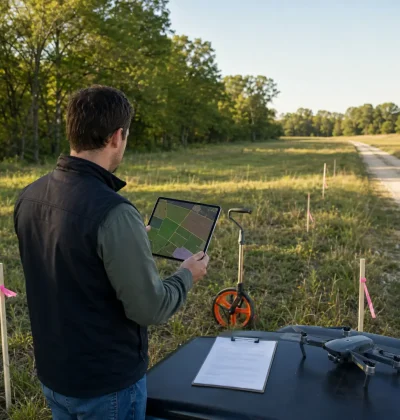
Find three to five vacant parcels near yours that sold recently and are similar in acreage, access, and zoning. County recorder and assessor records show sold prices for free, and your county GIS map helps you match parcels to boundaries. Calculate each one’s price per acre, then adjust up or down for how your land compares on road access, utilities, water, and terrain.
The adjustment step is where most DIY valuations go wrong, because it is tempting to average the comps and stop. Our walkthrough of a land comparable sales analysis shows how to weight the closest matches and what a defensible adjustment looks like.
You can also scan active listings to see what similar parcels are asking today, which helps in a rural market where recorded sales are thin. Listings are not sales, so weight them lightly, but they tell you what the market is currently testing.
Method 2: Check Your County Assessed Value (Free)
Your county assessor already puts a value on your land every year for tax purposes, and it is free to look up. Treat it as a rough reference, never a market price.
Find your parcel on the county assessor or property tax website using your APN or address. Assessed value is what the county uses to calculate property tax, and it is usually produced by mass appraisal formulas that lag the real market by a year or more. In many counties it runs well below true market value, and how far below varies enormously by state.
Use it as a sanity check with a floor and a ceiling. If your comps say $60,000 and the county assessed it at $58,000, that is reassuring. If the two are miles apart, find out why before trusting either one. Our comparison of assessed value versus market value explains where the gap comes from.
Method 3: Try an Online Land Value Estimator (Free)
An online land value estimator promises an instant answer, and it is worth a quick look, but understand what you are getting on raw land.
Most automated valuation models were trained mostly on home sales, where data is dense and properties are broadly similar. Vacant land is the structural opposite: far fewer sales, wildly different parcels, and value drivers like legal access and zoning that a home model was never built to weigh. That is not a bug someone will patch. It is what happens when you point a model at a market it has no data for.
The category is taken seriously enough to be regulated. A 2024 interagency federal rule sets quality control standards for AVMs used in mortgage lending, requiring firms to ensure “a high level of confidence in the estimates,” protect against data manipulation, and run random sample testing. Consumer-facing home estimators sit outside that rule, which is worth knowing before you price a parcel off one.
Use a general estimator for a fast ballpark, then verify against your comps. Never price land off a single automated number, especially in a rural area where the model has almost nothing to learn from.
Method 4: Use an AI Land Valuation Tool (Free With Trial)
AI land valuation sits between a free estimator and a paid appraisal, and it is built for the thing generic tools miss: land itself.
A purpose-built model pulls recent comparable land sales near your parcel and weighs dozens of factors including acreage, road access, zoning, utilities, and flood status, then returns a market value range with a confidence score rather than a single number. Because it is trained on land rather than houses, it handles access and per-acre scaling the way an experienced land buyer would.
Read the width of the range as information. A narrow band means local comps agree. A wide band means they do not, which is worth knowing before you pick a price rather than after the parcel has sat for four months. If you want the mechanism in detail, our explainer on how AI land valuation works covers the weighting.
An AI valuation is an estimate built from comparable sales, not a certified appraisal. Use it to set a defensible asking price, not to satisfy a lender.
Ours is free to run during the trial and included in every plan afterward. See what the land valuation tool reads, what it returns, and where its limits are before you rely on the number.
Method 5: Order a Professional Land Appraisal (Paid)
A licensed appraisal is the most authoritative number available, and the only one a lender, court, or tax authority will fully accept. It is also the slowest and most expensive.
A certified appraiser inspects the parcel, researches comparable sales, and produces a formal report following recognized standards of professional practice. Expect $500 to $1,500 for a simple rural parcel, and $1,500 to $3,000 or more for a large, complex, or high-value tract. Price tracks complexity, not just acreage.
Order one when the stakes require certainty: a buyer’s financing, an estate or divorce settlement, a property tax appeal, or an IRS matter. The IRS works from the same concept of fair market value that an appraisal establishes, defined in IRS Publication 561 as the price a willing buyer and willing seller would agree on, neither under compulsion and both reasonably informed. For a routine sale, comps plus an AI valuation usually get you there for free. This is general information, not tax or legal advice.
Does the Method Change by Land Type?
Yes, and this trips up more owners than anything except access. A method that works on a residential lot can mislead badly on specialized ground.
Recreational and hunting land carries value drivers a generic model has no data for: game population, timber stands, water features, and neighboring public land. Our guide to recreational land value covers what those are worth and how buyers price them.
Timber is its own discipline again, because standing timber can be a large share of total value and is priced separately from the dirt underneath it. See timber land value before you accept a per-acre figure on a wooded tract.
Regional variation is also larger than most owners expect. Comparing your parcel against the right region matters more than comparing it against the national average, and land value by state shows how wide that spread actually is.
How Do You Combine the Methods for an Accurate Number?
No single method is perfect, so stack two or three and look for agreement. That is how a guess becomes a price you can defend.
Start free with comparable sales and an AI valuation. If they land within a reasonable distance of each other, you have a strong working number. Use the county assessed value as a quick reality check on the floor. Reach for a paid appraisal only when a third party requires a certified figure.
The final test is always the market. Real buyer interest at your price tells you more than any tool, which is why the number you start with matters less than how fast you are willing to read the response and adjust. Our guide on how to price vacant land turns a range into an actual asking price based on your timeline.
What Mistakes Do Owners Make When Valuing Land?
A few avoidable errors cause most bad land valuations.
Do not price off a home-value tool. Do not assume larger parcels scale up in a straight line, because per-acre value usually falls as acreage rises. Do not ignore access, which can swing value more than any other single factor.
Do not confuse assessed value with market value, and do not anchor to what you paid or what you still owe, because the market does not care about either. And do not skip the disclosure factors: a flood zone a buyer finds on the FEMA Flood Map Service Center after making an offer will reset your price anyway, so you may as well price it in from the start.
So What Is Your Land Actually Worth?
Answering it is really about triangulating: comps for the market, an AI valuation for speed and depth, and an appraisal only when you genuinely need one. Get two of those to agree and you can price with confidence.
Then stop valuing and start testing. The number only becomes real when a buyer responds to it, which is why most owners learn more in the first two weeks of a live listing than in a month of research. When you have a number you believe, selling your land by owner walks through everything that happens next.
Ready to test your number against real buyers? Start free today and put your parcel in front of people actively searching for land.
Frequently Asked Questions
How do I find out how much my land is worth for free?
Pull comparable sales from your county recorder or assessor records, calculate each parcel’s price per acre, and adjust for access, zoning, and terrain. Then confirm the range with a free AI land valuation. Two free methods that agree give you a reliable working number without paying for an appraisal.
Is a land value estimator accurate for vacant land?
It depends entirely on what the model was trained on. Estimators built from home sales are unreliable on raw land, because land has far fewer comparable sales and different value drivers like legal access and zoning. A land-specific model handles those. Use any estimator as a ballpark, then verify against real comps.
How much does a land appraisal cost?
Expect $500 to $1,500 for a simple rural parcel and $1,500 to $3,000 or more for a large, complex, or high-value tract. Cost tracks complexity rather than acreage alone. An appraisal is worth it when a lender, court, or tax authority requires a certified value, but for a routine sale, free comps plus an AI valuation usually suffice.
What is the difference between assessed value and market value?
Assessed value is what your county assigns for property tax, usually using mass appraisal formulas that lag the market. Market value is what a buyer will actually pay today. The two can differ significantly in either direction, so use assessed value only as a sanity check, never as your asking price.
How is land value calculated per acre?
Find recent sales of similar nearby parcels, divide each sale price by its acreage to get a price per acre, then apply that rate to your acreage with adjustments for access, zoning, and terrain. Remember that price per acre usually drops as parcels get larger, so compare against parcels of similar size, not just similar location.
Resources and Further Reading
- USDA NASS Land Values 2026 Summary reports average farm real estate, cropland, and pasture values per acre and the year-over-year change.
- IRS Publication 561: Determining the Value of Donated Property defines fair market value and how it is established.
- Appraisal Institute: Standards of Professional Practice covers the standards a licensed appraisal is produced under.
- CFPB and interagency rule: Quality Control Standards for Automated Valuation Models sets the federal standards AVMs must meet in lending.
- FEMA Flood Map Service Center is the official lookup for a parcel’s flood zone.