Key Takeaways
How to work out what standing timber is worth, the one question to ask about any cruise, and the tax treatment most landowners never claim.
- Timber is a separate asset sitting on top of bare land value, so a wooded parcel can be worth well more than the ground alone.
- The method is volume times stumpage price, summed by product. A timber cruise supplies the volume; a state price report supplies the rate.
- Always ask which log rule a cruise used. Under the Doyle rule the actual board foot volume can be 40 percent higher than the estimate.
- No reliable national per-acre figure exists, and state forestry agencies say so about their own reports.
- An outright timber sale can qualify for capital gain treatment under IRC section 631(b), and your timber basis reduces the taxable gain.
If you own wooded land, the trees may be worth more than the ground under them, and most owners have never had the number calculated. Working out how much timber is worth per acre comes down to two things: how much timber is standing, and what buyers in your area are paying for it this quarter.
This covers the method foresters actually use, the question to ask about any volume figure you are handed, a worked example, the tax treatment, and when to stop estimating. For the bare land side, start with what your land is worth.
Quick verdict: you can get a defensible ballpark yourself by estimating volume and applying your state’s published stumpage prices, which is enough to decide whether to buy a wooded parcel or look into a sale. For an actual timber sale, hire a consulting forester, because an accurate cruise and a competitive bid process usually recover more than the fee. Treat every online per-acre timber figure as a starting point and never as a valuation. This is general information, not tax or legal advice.
How Do You Calculate Standing Timber Value?
Volume times stumpage price, summed across every product on the tract. The formula is trivial. The accuracy lives entirely in the volume.
Stumpage is the price a buyer pays for timber as it stands, before it is cut. It is already net of the buyer’s logging and hauling costs, which is why access and distance to the mill come straight out of your number.
Timber sells as products, each with its own unit and its own price. Sawtimber, the large stems milled into lumber, is measured in board feet and usually quoted in thousands, written MBF. Smaller stems sold as pulpwood are measured in tons or cords. A single stand can therefore earn a sawtimber rate per MBF and a separate pulpwood rate per ton in the same sale.
So the calculation is: sawtimber MBF times the sawtimber rate, plus pulpwood tons times the pulpwood rate. Everything difficult is upstream of that, in the measurement.
What Is a Timber Cruise, and Which Log Rule Did It Use?
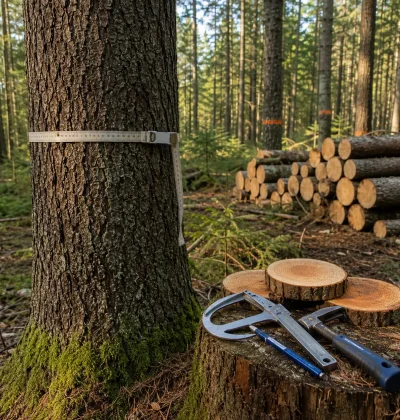
A cruise is a systematic sample of your woods that estimates volume by species and product. A forester lays out sample plots, measures the trees on each, and scales the result to the whole tract.
On every plot the forester records species, height, and trunk diameter measured at breast height, 4.5 feet above the ground. Those measurements run through volume tables and come out as MBF of sawtimber and tons or cords of pulpwood, broken out by species. Without a cruise, any timber value is a guess, because two tracts of identical acreage can hold completely different volumes depending on age, stocking and past cutting.
Then ask the question almost nobody asks: which log rule was used?
A board foot figure is not a fact on its own. It is the output of a scaling rule, and the common rules disagree. Penn State Extension’s guide to valuing standing timber puts it plainly: the Doyle rule “greatly underestimates the actual board foot yield of small diameter logs”, the International 1/4-inch rule “is the most accurate predictor of actual yield of the commonly used rules”, and “if selling based on the Doyle rule, one needs to understand that the actual board foot volume may be 40 percent greater than the Doyle estimate.”
That has two practical consequences. Two cruises of the same trees can report volumes 40 percent apart, and two offers quoted per MBF are not comparable unless both name the same rule. Doyle is common in the South, Scribner in the West, International 1/4-inch where accuracy matters most. Get the rule in writing on the cruise report and on every bid.
What Drives the Number?
Species, size, quality, stocking, access and haul distance, on top of whatever the market is doing this quarter.
| Factor | Raises value | Lowers value |
| Species | High-demand hardwood, veneer-grade oak or walnut, quality pine | Low-value or cull species |
| Tree size | Large-diameter sawtimber and veneer stems | Small-diameter pulpwood only |
| Quality and grade | Straight, clear, defect-free logs | Crooked, knotty, damaged stems |
| Stocking per acre | Dense, well-stocked stands | Thin or previously high-graded woods |
| Access | Good roads, gentle terrain, dry ground | Landlocked, steep, or wet |
| Haul distance | Several mills within easy reach | Long haul to the nearest buyer |
Size and grade matter more than most owners expect, because a large straight veneer stem can be worth many times a small pulpwood stem of the same species. Access and haul distance matter for a mechanical reason: logging costs come out of stumpage, so a hard tract simply pays less for the same trees.
If access is the open question on your parcel, our due diligence checklist covers how legal access is actually confirmed.
Worked Example: a 40-Acre Tract
Illustrative only. The prices below are examples, not current market rates, because real stumpage varies by region, species, product and quarter. The arithmetic is the point.
Say a cruise on a 40-acre pine tract reports 6,000 board feet of sawtimber per acre and 12 tons of pulpwood per acre, scaled under the International 1/4-inch rule. That is 240,000 board feet, or 240 MBF, and 480 tons across the tract.
Apply an illustrative $350 per MBF for the sawtimber and $10 per ton for the pulpwood:
- Sawtimber: 240 MBF x $350 = $84,000
- Pulpwood: 480 tons x $10 = $4,800
- Total: $88,800, or about $2,220 per acre
Now hold the trees constant and move only the price. The same 240 MBF is worth $60,000 at $250 per MBF, $84,000 at $350, and $120,000 at $500. Nothing about the timber changed. That spread is why a single per-acre figure from an article, including the one above, tells you almost nothing about your own woods.
And had that cruise been scaled under Doyle instead, the same trees could carry a materially smaller board foot figure while the wood on the ground stayed exactly the same.
Why Is There No Reliable Per-Acre Figure?
Because stumpage depends on species, product, local mill demand and the quarter you sell in, and none of those hold still.
The agencies that publish price reports say so themselves. The South Carolina Forestry Commission attaches an acknowledgement of pricing fluctuation to its own quarterly figures, stating that they “reflect average stumpage prices for the quarter from timber sales of all sizes spread across a variety of ownerships and a large geographic area”, that they “should be used as a general guide for price and price trends only and should not be used to substitute for a professional appraisal”, and that the actual price a landowner receives “might be considerably higher or lower than the prices in this report due to differences in timber volume, timber quality, accessibility, and effects of local supply and demand.”
That is the most honest sentence in the industry, written by the people publishing the numbers.
So use the reports for the right job. They tell you the direction and the rough level for your species and product in your state, which is what you need to sanity-check an offer. They do not tell you what your tract is worth. Most state forestry agencies and university extension services publish one, usually quarterly and usually free.
How Is a Timber Sale Taxed?
Often better than landowners expect, and the reason is worth knowing before you sell rather than after.
Under Internal Revenue Code section 631(b), an outright sale of standing timber can be treated as capital gain rather than ordinary income. The IRS instructions for Form T (Timber) state that “certain rules under section 631(b) allow the landowner to treat outright sales of timber as capital gain.”
Two things follow that most owners never act on.
Your timber has a cost basis, and depletion reduces the taxable gain. When you bought or inherited the land, part of what you acquired was the standing timber, and that portion can be allocated as timber basis. An owner who never made that allocation can end up paying tax on the entire cheque instead of on the gain. On inherited land the stakes are higher, because basis steps up at the date of death, which is covered in our guide to selling inherited land.
Form T is not always required. Per the same instructions, you attach it only if you claim a deduction for depletion of timber, elect under section 631(a) to treat cutting as a sale or exchange, or make an outright sale under section 631(b). And “you are not required to file Form T if you only have an occasional sale of timber (one or two sales every 3 or 4 years)”, though records still have to show the adjusted basis for depletion, fair market value, and gain or loss on each sale.
Timber taxation has more moving parts than one section of an article can settle. Establish your basis before the sale, keep the records the instructions describe, and work with a CPA who has handled timber. This is general information, not tax advice.
Should You Hire a Consulting Forester?
For a ballpark, no. For an actual sale, almost always yes.
A landowner can pace rough acreage, apply state price reports and land on a usable order of magnitude. That is enough to decide whether a wooded parcel is worth pursuing or whether a sale is worth exploring.
A consulting forester does three things that are hard to replicate alone: runs an accurate cruise, prices the timber against current local markets, and puts the sale out to competitive bid among multiple buyers. Penn State Extension’s assessment is blunt: “study after study has shown that they more than pay for their service by the increased price you will get when you know what you are selling and what its value is.”
The competitive bid is usually where the money is. A single unsolicited offer from one buyer has nothing to beat. You can find a credentialed professional through the Association of Consulting Foresters’ find a forester directory, and most state forestry agencies also publish a list.
How Does Timber Fit Into Total Land Value?
It sits on top. Price the dirt and the trees separately, then add them.
A buyer of wooded land is paying for three things: the ground, the standing timber, and the future growth. Value only the ground and you underprice the parcel. Value only the timber and you have priced a harvest, not a property.
For the bare land side, work from comparable sales of similar parcels. Our guide to land comps sets out how to build and adjust that set, then you add the cruise-based timber figure on top of the result.
Cross-check the land number against the USDA’s 2026 Land Values summary, which publishes per-acre averages by state and land type. Your county will differ, but a bare land figure landing far outside that range is worth a second look.
The other variables that move the land half, access, use, zoning and location, are covered in factors that affect land value.
If you are comparing asking prices on wooded parcels, the price per acre shown on active listings is a quick reality check on the land side, though a listing will rarely tell you what timber is included in the number.
What Do Landowners Get Wrong?
Four mistakes, in rough order of what they cost.
Selling on the first offer with no cruise and no competition. One buyer, one number, nothing to benchmark it against. This is the expensive one.
Comparing offers scaled under different log rules. A higher price per MBF on a Doyle scale can be worth less than a lower price on an International scale. Always compare like with like.
Never establishing a timber basis. The tax bill arrives after the sale, when it is too late to allocate.
Cutting immature timber. Small-diameter stems sell as pulpwood. Left to grow into sawtimber and veneer, the same trees move into a different price bracket entirely.
Behind all four sits the same habit: treating an online per-acre average as a valuation. Get a cruise, get your state’s current prices, get the log rule in writing, and get more than one buyer to the table.
Price the Land and the Trees Separately
The trees and the ground are two assets and they sell on two different markets. Value them apart, then add them, and you will not underprice either one.
Start with the ground. Start with the land number, then add a cruise-based timber figure on top of it.
Frequently Asked Questions
How much is an acre of timber worth?
It ranges from a few hundred to several thousand dollars per acre depending on species, tree size, stocking, access and current stumpage prices. No reliable single figure exists, and state forestry agencies say their own published averages should not substitute for an appraisal. Only a cruise plus current local prices gives a real number for your tract.
How do I find out what my timber is worth?
Have a consulting forester cruise the tract to measure volume by species and product, then apply current local stumpage prices to each product. Volume times price, summed across sawtimber and pulpwood, is your standing timber value. For a rough figure you can estimate volume and use your state forestry agency’s quarterly price report.
What is stumpage price?
Stumpage is what a buyer pays for standing timber as it stands, before it is cut and hauled. It is quoted per unit, such as dollars per thousand board feet for sawtimber or per ton for pulpwood. Stumpage is already net of the buyer’s logging and hauling costs, which is why access and haul distance change it.
Why does the log rule matter?
Because a board foot figure is the output of a scaling rule, and the rules disagree. The Doyle rule underestimates small-diameter logs, and actual volume can run 40 percent above a Doyle estimate. Two offers quoted per thousand board feet are not comparable unless both name the same rule, so get it in writing.
Is money from selling timber taxable?
Yes, but the treatment can be favourable. Under IRC section 631(b) an outright sale of standing timber can qualify as capital gain rather than ordinary income, and your timber basis reduces the taxable gain through depletion. Establish that basis before you sell and speak to a CPA experienced with timber. This is not tax advice.
Resources and Further Reading
- Penn State Extension: Valuing Standing Timber explains the common log rules and states that actual volume can be 40 percent above a Doyle estimate.
- IRS Instructions for Form T (Timber) set out capital gain treatment under section 631(b), the depletion and basis records required, and the occasional-sale exception.
- South Carolina Forestry Commission: acknowledgement of pricing fluctuation is a state agency stating what its own published stumpage averages can and cannot be used for.
- Association of Consulting Foresters: Find a Forester is a searchable directory of credentialed consulting foresters who represent landowners.
- USDA NASS Land Values 2026 Summary publishes per-acre averages by state and land type as a baseline for the bare land side.