
Key Takeaways
Why soil sets septic cost, what EPA’s system types are actually for, and the site conditions that make a zoned parcel unbuildable.
- Cornell states that soil conditions determine the type of system that can be installed, which means the system type is a diagnosis rather than a choice.
- Every alternative system on EPA’s list exists because the soil refused a conventional one, and alternatives cost multiples of conventional.
- EPA’s published mound breakdown puts the tank at the small end and the dispersal field at roughly six times it, which is the cost structure that matters.
- Cornell lists seven site conditions that disqualify a conventional system, including thin or rocky soils, clay, high water tables and steep slopes.
- No septic permit usually means no building permit, so a parcel can be correctly zoned residential and still be unbuildable.
Ask what a septic system costs and the honest first answer is another question: what does the soil do. That is not evasion. It is the actual mechanism, and it is why two identical houses on two adjacent parcels can carry septic costs that differ by a factor of several.
Most pages on this subject quote a range built from national home-services data, which is drawn overwhelmingly from replacing failed systems at existing houses. Raw land is a different problem. There is no existing system to copy, no history of what worked, and no guarantee the ground will accept effluent at all.
Written for someone evaluating undeveloped acreage who needs to know what a system will cost and, more importantly, whether one is possible. It covers what drives the number, EPA’s system types and what each is for, the site conditions that disqualify a conventional system, and when to test. This is general information rather than engineering or legal advice, and your county health department and a licensed site evaluator are the only sources that can answer it for your parcel.
Quick verdict: do not budget a septic system before a soil evaluation, because the evaluation determines the system and the system determines the cost. Make the offer contingent on a passing result. A failed evaluation on land you already own is the most expensive outcome in this entire subject.
What does a septic system cost on raw land?
It costs whatever the soil dictates, and the range between the cheapest and most expensive answer on the same sized house is wide enough that a single national average is not useful. A conventional gravity system in good soil sits at the bottom. An engineered alternative in poor soil sits several times higher.
EPA is direct about why. In its guidance on types of septic systems the agency states that design and size “can vary widely, both within and between communities” because of “a combination of factors” including “household size, soil type, site slope, lot size, proximity to sensitive water bodies, weather conditions, or even local regulations.”
Read that list and notice how much of it is about the ground rather than the building. Four of the six factors describe the site. That ratio is the whole article, and it is why the number you want does not exist until somebody digs a hole on your parcel.
Why does soil set the price instead of house size?
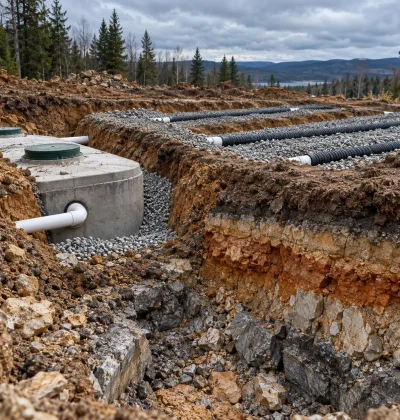
Because the soil is doing the treatment, and the tank is only doing the separation. EPA’s explanation of how septic systems work describes the drainfield as “a shallow, covered, excavation made in unsaturated soil” where “the soil accepts, treats, and disperses wastewater as it percolates through the soil, ultimately discharging to groundwater.”
The tank is a settling chamber. The actual work of removing bacteria, viruses and nutrients happens underground, in the dirt, by percolation. So the question a system designer is answering is not how many people live here. It is how fast and how well this specific ground will accept water.
When it will not, the consequences are immediate. EPA warns that if the drainfield “is overloaded with too much liquid, it can flood, causing sewage to flow to the ground surface or create backups in toilets and sinks.” Every engineered alternative on the market exists to prevent exactly that on ground that cannot do the job unaided, and engineering costs money.
What does EPA say each system type is for?
Each type maps to a specific site problem, which is the most useful way to read the list. Nobody picks a mound because they like mounds.
| System | What it is for, per EPA |
| Conventional gravel or stone | Adequate soil and space. Large footprint, “may not be suitable for all residential sites or conditions” |
| Chamber | High groundwater tables, variable flow such as vacation homes, areas short of gravel |
| Drip distribution | Sites where large soil mounds are not feasible. Shallow infiltration, needs electrical components |
| Aerobic treatment unit | “Smaller lots, inadequate soil conditions,” and “areas where the water table is too high” |
| Mound | Shallow soil depth, high groundwater, shallow bedrock |
| Recirculating sand filter | High water tables and proximity to water bodies. Superior nutrient treatment |
| Evapotranspiration | Arid climates only. Fails with excessive precipitation |
| Constructed wetland | Sites that can accommodate wetland vegetation and an impermeable liner |
| Cluster or community | Rural subdivisions and multiple dwellings under common ownership |
The pattern is unmistakable once you see it. Conventional is the default. Everything below it is a workaround for a specific ground condition, and each workaround adds components, power, or both. The same logic runs through every other site input, which is why your land is worth less when the ground forces engineering that a neighboring parcel does not need.
What does a mound system actually cost to build?
EPA’s own fact sheet gives a breakdown, and the proportions in it are more useful than the total. For a three-bedroom home the capital cost is put at approximately $9,750: $1,000 for the septic tank, $2,000 for the dosing chamber with pump, and $6,000 for the mound itself, plus site evaluation and permits.
A caveat that matters more than the figure. That mound systems fact sheet is an older EPA publication, so treat those numbers as cost structure rather than a current quote. Materials and labor have moved since.
What has not moved is the structure, and it is the thing to take away. The tank is the cheapest component. The dispersal field is roughly six times it. Every conversation that focuses on tank size is focusing on the small line, and that is why “how much is a 1,000 gallon tank” is the wrong question to ask a contractor first.
Operation costs follow the same logic. EPA notes mounds need minimal maintenance when properly installed, but require annual checks of the dosing chamber, pump and floats, plus routine tank pumping every three years, at $75 to $150 annually. A conventional gravity system has no pump to check because it has no pump.
What disqualifies a site from a conventional system?
Cornell publishes the clearest list, and it works as a pre-offer checklist. A property is unsuitable for a traditional tank and drainfield when it has insufficient soil volume or depth for treatment, sits within the ten-year flood zone, has excessively steep slopes, has thin or rocky soils, has clay soils with poor drainage, has a high water table that saturates the drainfield, or is simply too small to place the system.
Three of those are visible from a site walk. Steep slope, obvious rock, and standing water after rain are all things a buyer can see before spending anything. The rest need a shovel.
None of them mean the land is worthless. They mean the land carries an engineering bill that a better parcel does not, and that bill belongs in your offer price rather than in a surprise after closing. Working through these alongside the rest of the raw land due diligence checklist is how that adjustment gets made at the right moment.
How does bedroom count change the system size?
It sets the minimum tank capacity and the minimum surface area, which is the one part of the sizing that does follow the house. Cornell publishes the standard:
| Bedrooms | Minimum tank capacity | Minimum surface area |
| 1 to 3 | 1,000 gallons | 27 sq ft |
| 4 | 1,250 gallons | 34 sq ft |
| 5 | 1,500 gallons | 40 sq ft |
| 6 | 1,750 gallons | 47 sq ft |
Cornell notes those are minimums, and that larger tanks give better solids separation and less frequent pumping.
Two things follow. Bedroom count is a step function rather than a smooth curve, so going from three bedrooms to four moves you up a tier while three to two changes nothing. And because the tank is the cheap component, adding a bedroom costs less in septic terms than most people fear. If you are planning a build, working the sizing out early is part of knowing what it takes to buy land to build a house without surprises.
Can a parcel be zoned residential and still fail?
Yes, and this is the single most expensive misunderstanding on raw land. Zoning and soil answer two different questions, and buyers routinely check only the first.
Zoning tells you what you are permitted to build. Soil tells you what the ground will physically accept. A parcel can be correctly zoned single-family residential, sit in a subdivision of houses, and still fail a soil evaluation, because zoning is a legal designation drawn on a map and soil is a physical property measured in a hole.
The consequence is procedural and it is severe. In most counties a building permit requires an approved septic permit, and an approved septic permit requires a passing soil evaluation. Fail the evaluation and the building permit does not issue. The parcel is not unbuildable on paper. It is unbuildable in fact, while remaining zoned for exactly the thing you cannot do.
This is why a zoning check alone is not diligence. It confirms the permissive layer and tells you nothing about the binding one. Anyone buying acreage for an eventual home, and particularly anyone looking at off-grid land for sale where no municipal sewer will ever arrive, is buying the soil as much as the acreage.
When should you test the soil, before or after the offer?
Make the offer, and make it contingent on a passing evaluation. That sequence protects you in both directions and it is how experienced buyers handle it.
What the evaluation measures is straightforward. Cornell’s guide to your septic system describes a percolation test as measuring “how long it takes a set volume of water to soak into the soil,” which is the number the whole design hangs on.
Testing before an offer means paying for an evaluation on land you may not buy, on a parcel you have no right to enter without the owner’s permission. Testing after closing means owning the answer whatever it is, which is the worst position available.
A contingency puts the cost where it belongs and the risk where it belongs. If the evaluation passes, you proceed with a real number. If it fails, you walk, or you renegotiate against the engineering bill the result just produced. The soil test itself carries the highest cost-per-click value in this entire keyword set, which tells you something about how much the answer is worth to people who need it.
What ongoing costs come with an alternative system?
Power, parts and inspections, none of which a conventional gravity system carries. That is the part of an alternative system that does not show up in the installation quote.
Anything with a pump has a pump to replace. EPA’s mound guidance calls for annual checks of the dosing chamber, pump and floats. Aerobic treatment units run a blower continuously, which is an electricity bill that never stops, and many states require a service contract on them as a condition of the permit.
Design life is the counterweight. Cornell puts it at 20 to 30 years under the best conditions, with well-maintained systems lasting decades. Spread over that horizon the maintenance is manageable. Over the first five years, on a buyer who did not budget for it, it is an unpleasant surprise. When you are comparing buying rural land against parcels with different soil, this recurring cost belongs in the comparison too.
What mistakes cost buyers the most?
Four, in rough order of cost.
Checking zoning and skipping soil. Zoning is permissive and soil is binding, and only one of them can stop the build.
Budgeting from a national average. That figure is dominated by replacements at existing houses in known-good soil, which is the opposite of your situation.
Buying without a contingency. A failed evaluation on land you already own leaves you with an engineering bill, a much smaller buyer pool, or both.
Pricing the tank instead of the field. EPA’s own breakdown puts the dispersal field at roughly six times the tank. Most buyers negotiate the small line.
Does a septic system add value when you sell?
An installed, permitted, functioning system adds more than it cost, because it converts a question into a fact. A buyer looking at bare acreage is pricing in the risk that the ground fails. A buyer looking at a permitted system is not pricing that risk at all.
A passing soil evaluation with no system installed captures a good share of that benefit for a fraction of the outlay. It is the cheapest thing a seller of raw acreage can do to remove the largest objection a buyer has, and it is documentation rather than construction.
What does not pay is installing an expensive engineered system speculatively before you know who is buying or what they intend to build. Sizing follows the house, and you do not know the house. Sell the evaluation, not the system, and let the buyer build to their own plan. Parcels that come to market with that work already done are the ones that move, which is visible if you browse land listings from owners who have done it.
Shortlist parcels with a passing soil test
Frequently Asked Questions
How much does a new septic system cost on raw land?
It depends on the soil evaluation, because that determines the system type and the type determines the cost. Conventional gravity systems in good soil are cheapest. Mounds, aerobic treatment units and drip systems all cost more because they engineer around ground that cannot accept effluent unaided. Get the evaluation before budgeting.
What is the difference between a conventional and alternative septic system?
A conventional system relies on the native soil to treat and disperse effluent through a drainfield. Alternative systems add engineering when the soil cannot do that, whether through elevated sand in a mound, aeration in a treatment unit, or shallow drip distribution. Per EPA, each alternative targets a specific site condition such as shallow bedrock or a high water table.
Can you get a septic permit on any land?
No. A septic permit requires a passing soil or percolation evaluation, and Cornell lists thin or rocky soils, clay, high water tables, steep slopes, flood zone location and small lot size among the disqualifiers. Because most counties require an approved septic permit before a building permit, a failed evaluation can make correctly zoned land unbuildable.
How long does a septic system last?
Cornell puts the design life at several decades, typically 20 to 30 years under the best conditions, with well-maintained systems lasting longer. Alternative systems with pumps and blowers have more components that fail earlier, so factor replacement parts and, for aerobic units, continuous electricity into the long-term cost.
Resources and Further Reading
- EPA, Types of Septic Systems Every system type and the specific site condition each one addresses.
- EPA, How Septic Systems Work The drainfield, percolation, and what happens when soil cannot absorb effluent.
- EPA, Mound Systems fact sheet Component cost breakdown and maintenance requirements, older publication.
- Cornell Waste Management Institute, Your Septic System Site disqualifiers, bedroom sizing table and design life.