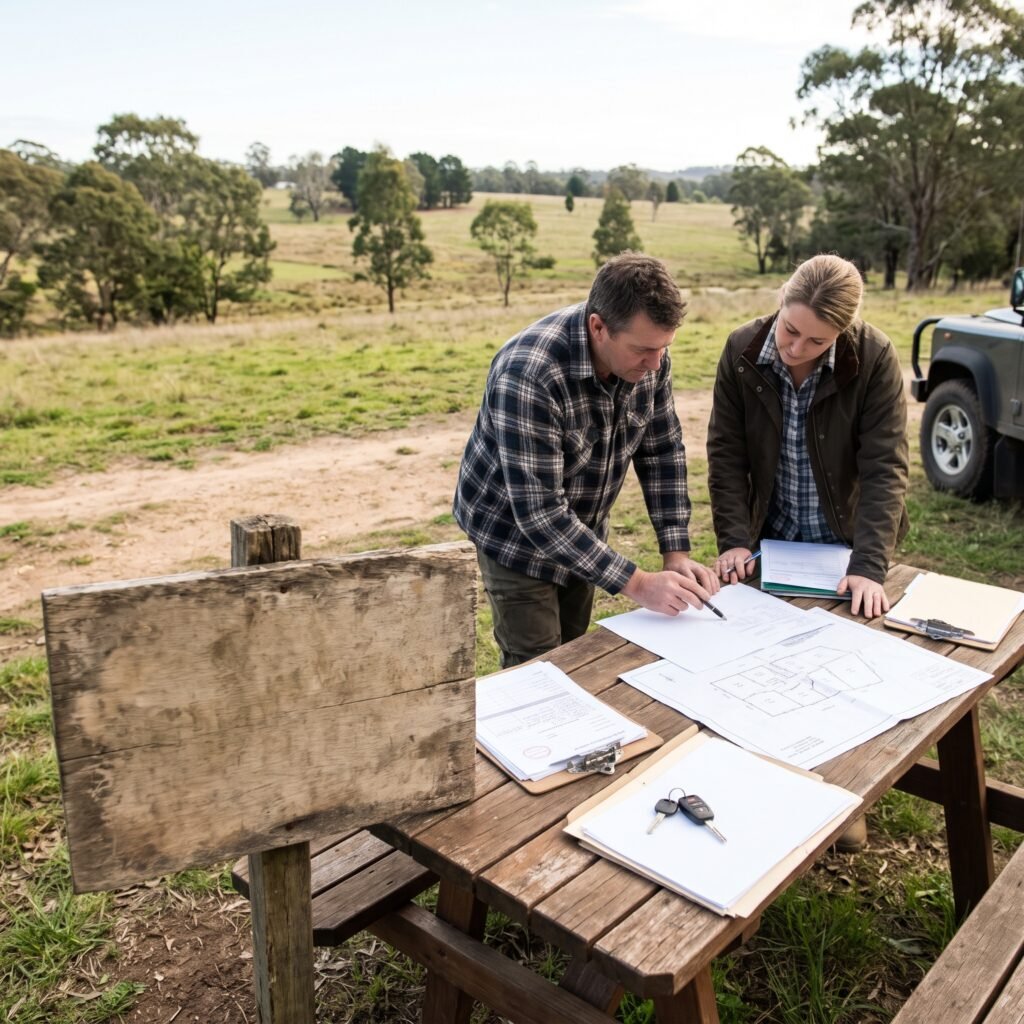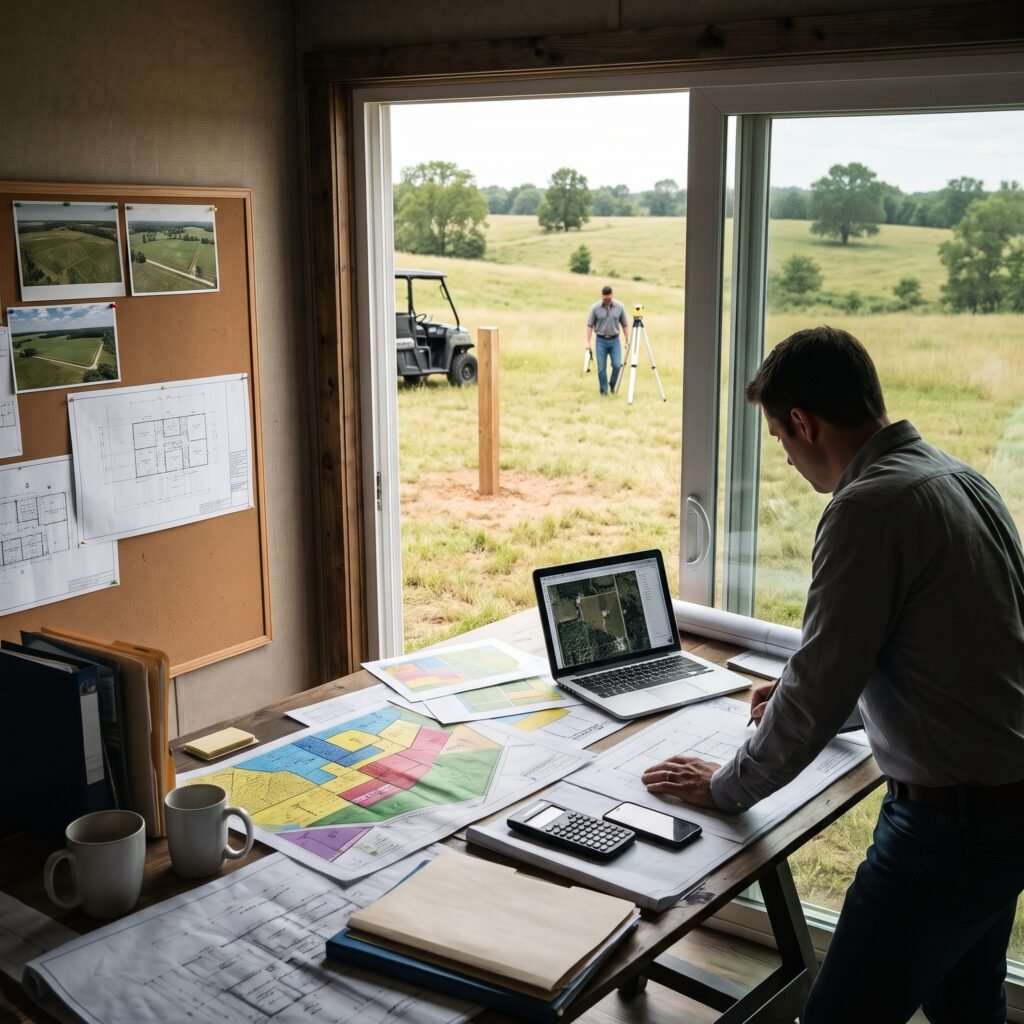
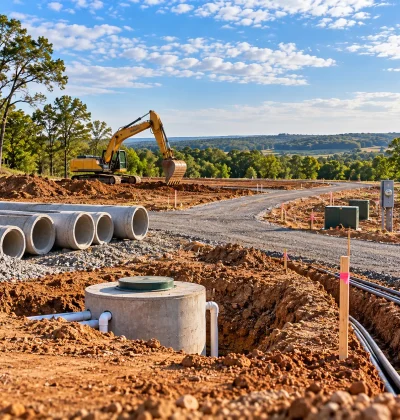
Key Takeaways
Every land development cost figure here traces to a named government document, plus the subdivision trigger that most buyers get wrong.
- Published USDA conservation schedules price brush clearing between $27.55 and $1,195.98 per acre in a single state and year, a spread of more than forty times.
- A water well runs from $3,926.90 to $22,894.40 on one state’s published scenarios, driven as much by casing width as by depth.
- EPA’s mound system fact sheet breaks a three-bedroom system into $1,000 tank, $2,000 dosing chamber and $6,000 mound, totaling $9,750.
- County permit fees are the only fully knowable figure in advance, and they range from $250 to $650 across two counties in one state.
- Whether a split requires a new street, not how many lots it creates, is what separates a cheap subdivision from one that funds roads to state highway standard.
Nobody can tell you what it costs to develop your parcel, and every page that gives you one number is guessing. The honest version of this question has a different shape: which line items exist, which are knowable in advance, which scale with what, and which single decision moves the total by an order of magnitude. That last one is the part almost everyone misses, and it has nothing to do with dirt.
What follows is a land development cost breakdown where every figure is quoted from a government document anyone can open. The numbers come from different states and years, so they describe the shape of the cost rather than a national total and should not be added together. Written for someone buying raw or rural land who intends to build, split or resell it improved. Development rules are state and county law, so this is general information rather than legal advice.
Quick verdict: budget in four buckets, not one line. Permits are knowable today, site work scales with acreage and terrain, water and wastewater scale with the house you intend to build, and subdivision improvements are all or nothing. Find out whether your intended split triggers a new street before you price anything else, because that single answer can outweigh every other item combined.
What does it actually cost to develop raw land?
There is no credible single figure, but there are credible published ones per component. The USDA Natural Resources Conservation Service prices conservation practices by state and year through its payment schedules, built from that state’s own labor and material costs, and they are the closest thing to a public price list for land work.
Four buckets organize everything that follows.
| Bucket | What it includes | How it behaves |
| Permits and testing | Soil evaluation, well permit, septic permit, driveway permit | Fixed, published, knowable today |
| Site work | Clearing, grubbing, debris, grading, access | Scales with acreage and terrain |
| Utilities | Water supply, wastewater, power | Scales with the building, not the land |
| Subdivision improvements | Streets, stormwater, utility extensions, dedication | All or nothing, triggered by one rule |
One caveat on every NRCS figure here: those are cost-share reimbursement rates for conservation work, not contractor invoices. Treat them as a sourced reference point, not a quote.
Why does nobody publish one number?
Because the inputs vary more than the output, and averaging them destroys the information. A national average of a figure that ranges forty times within one state tells you nothing about your parcel.
The variance is not noise. It is soil, slope, depth to water, distance to the nearest utility pole, what grows on the site, and which county you are in. Two adjacent parcels can differ fivefold on the same line item, which is why anyone learning how to buy vacant land should treat development cost as a per-parcel investigation rather than a lookup.
The useful question is not what it costs. It is which of these costs you can pin down before closing and which you are accepting as a range. Permits are the first kind. Almost everything else is the second.
What does clearing and grading cost?
Published conservation rates put brush management between $27.55 and $1,195.98 per acre. That is eleven scenarios in one state, West Virginia, in one fiscal year, under a single practice code, and the spread is more than forty times.
The scenarios explain the range. Chemical treatment by aerial application sits at the bottom. Mechanical work on large shrubs at medium infestation runs $303.81, and mechanical work on one acre or less runs $398.10 because mobilization spreads across fewer acres. Biological treatment at high density reaches $1,195.98.
Debris is a separate practice and a separate bill. Woody residue treatment in that same schedule runs $137.80 to $2,440.48, and it is the line most often left out of a clearing quote.
Two consequences. Per-acre pricing is not portable between parcels of different sizes, because the small-parcel penalty is real and large. And what grows on the land matters as much as how much of it there is, which is worth establishing when working out what to look for when buying land before you make an offer.
What does a water supply cost?
Between roughly $3,900 and $22,900 for a drilled well, on published figures. Connecticut’s NRCS water well scenarios run from a 50-foot, 4-inch well at $3,926.90 to an 800-foot, 8-inch well at $22,894.40.
The driver is not only depth. At an identical 400 feet, the 4 to 6 inch scenario is $7,007.04 and the 8 inch scenario is $10,939.12, about 56 percent more for the same hole depth. Casing width tracks the yield you need, and yield is a separate axis from depth.
Depth behaves unintuitively at the shallow end. Iowa’s schedule prices a 48-foot large-diameter well at $9,371.95 and a 300-foot deep well at $8,594.47. The shallow one costs more, because diameter and drilling method outweigh footage when the hole is short.
Add the pump, pressure tank, drop pipe and electrical supply, none of which sit in the drilling figure, and the working water supply costs meaningfully more than the quoted well.
What does wastewater cost?
EPA’s fact sheet on mound systems puts a three-bedroom mound at approximately $9,750, broken into $1,000 for the septic tank, $2,000 for the dosing chamber with pump, and $6,000 for the mound itself. That is an older EPA publication, so treat the proportions as more durable than the absolute figures.
Read the breakdown rather than the total. The tank is cheap. The dispersal field is expensive, and a mound is what you build when the soil will not accept effluent in a conventional drainfield. A site that passes for conventional dispersal skips most of that $6,000.
Operating cost follows the design. The same source puts maintenance at $75 to $150 annually with pumping every three years, because a mound has a pump and a gravity system does not. The system your soil forces on you is the one you maintain for thirty years.
What do the permits and tests cost?
This is the one bucket you can price today, for free, before you own anything. Mecklenburg County, North Carolina publishes a septic system fee schedule listing a residential soil test and improvement permit at $250 and a full new system package at $650 including all required permits and inspections.
Neighboring practice differs sharply. Wilson County in the same state charges a new lot evaluation by proposed design flow, from $400 for a one or two bedroom house up to $600 for seven bedrooms or more. The county is not pricing your land. It is pricing the load your plan puts on it.
Two counties in one state, a 1.6 to 2.4 times spread, and one of them scaling by bedrooms. Pull your own county’s published fee schedule before you budget anything else. It is the only figure in this subject that is fixed and verifiable in advance.
Are these costs additive, or does the order matter?
The order matters enormously, and treating the budget as a sum is the most expensive framing error in this subject. These costs form a sequence where a finding at step four can invalidate money already spent at step two.
Clear a building site, then fail the soil evaluation there, and the clearing was spent in the wrong place. Drill a well, then discover the permit class only supports household use when the plan was irrigation. Grade an access route, then learn the culvert needs a permit the county will not issue at that location.
The defense is cheap and almost nobody uses it. Run the tests that can disqualify a site before spending on anything that assumes the site works. Soil evaluation, well permit class and access approval cost hundreds. Clearing, drilling and grading cost thousands, and none of them should go first.
That ordering logic is the spine of a proper due diligence checklist, and it is worth building the sequence before you build the budget.
What changes if you want to split the parcel?
Everything, and the trigger is not what buyers expect. Most people assume the threshold between a simple split and an expensive one is the number of lots. In published ordinances it is usually whether the division requires a new street.
Onslow County, North Carolina’s subdivision ordinance defines a Minor Subdivision Type I as a division into 10 or fewer lots, including the residual parcel, where each lot has street frontage along an existing public or private street, where no new street improvements or right-of-way dedication is required, and where no water or sewer utility extensions are required.
A Major Subdivision is anything that does not qualify, and its public streets must be built to NCDOT Subdivision Roads Minimum Construction Standards.
So ten lots can be minor and two lots can be major. A parcel with frontage across its width supports multiple splits cheaply. A deep parcel whose rear ground is reachable only by a new street crosses into road construction to state standard for two lots. Same acreage, same county, different answer, and the difference is geometry rather than arithmetic.
What does a major subdivision require you to fund up front?
More than the construction cost, because most states require the money to be posted before the work is done. Virginia’s mandatory subdivision provisions require ordinances to cover the extent to which streets are graded, graveled or otherwise improved, and how water, storm and sanitary sewer and other public utilities or community facilities are installed.
Then comes the part that catches people. The developer must furnish one of three things: certification that construction costs have been paid, a certified check or cash escrow in the amount of the estimated costs of construction or a bond with satisfactory surety, or a bank letter of credit. The guarantee may include a reasonable allowance for administrative costs, inflation and potential damage to existing roads or utilities, capped at 10 percent.
Read that as working capital, not a fee. You are tying up the full estimated construction cost, plus up to 10 percent, as cash, bond or credit before the first load of gravel arrives.
So the honest advice on splitting land is unglamorous. Establish whether your intended division triggers major review before pricing anything else, because that answer can outweigh every other line item combined.
Which costs scale with acreage and which do not?
Three different scaling rules operate at once, and mixing them up is how budgets go wrong. Clearing and grading scale with acreage. Water and wastewater scale with the building. Permits and testing are close to fixed.
The consequence is counterintuitive. Doubling your acreage does not double your development cost if you are building one house, because the well, the septic system and most permits are sized to the dwelling rather than the land. Extra acres add clearing only if you actually clear them.
It cuts the other way on small parcels, where mobilization does not shrink and the fixed permit and utility costs land on a smaller base. Anyone weighing how much does an acre of land cost against development spend should compare total developed cost, not price per acre.
Subdivision improvements follow none of these rules. They are a step function triggered by a regulatory test, and they apply in full or not at all.
What gets left out of most development budgets?
Four items, consistently, and together they are not small. Debris disposal, the pump and pressure system, electrical service to the building site, and the driveway or access culvert.
Access surprises people most. A usable rural driveway may need base material, a culvert, and in many counties a road authority permit before it meets a public road. None of that appears in a clearing or well quote.
Power belongs in the same category. If the nearest service point is far from the building site, the utility extension can rival the well, and where that number is prohibitive an off-grid design becomes the cheaper path rather than the ideological one. That changes the whole budget shape for anyone buying land to build a house well off the road.
The fourth is time. Testing seasons, permit queues and utility scheduling all carry holding cost on financed land, and no invoice names it.
How do you budget a parcel you have not bought yet?
Build the four buckets, fill only the ones that are knowable, and put an honest range on the rest rather than a false point estimate. The goal is not precision. It is knowing which unknowns can hurt you.
Do four things before you commit. Pull the county fee schedule, which is free and exact. Establish whether your intended use or split triggers major subdivision review. Get the soil and water answers before spending on anything physical. And ask one local contractor for a depth or scenario range rather than a per-unit rate.
Then price the parcel against the developed total rather than the asking price. Two parcels at the same price per acre are not the same purchase if one needs a new street and the other fronts an existing one.
A parcel that already carries a passing soil evaluation, a filed well log and road frontage has had its largest unknowns converted into knowns by somebody else. When you browse land listings those are worth a premium, and the premium is usually smaller than the risk it removes.
Compare parcels before you budget site work
Frequently Asked Questions
How much does it cost to develop land?
There is no reliable single figure, but published government schedules price the components. Brush clearing runs $27.55 to $1,195.98 per acre in one state’s USDA schedule, a drilled well $3,926.90 to $22,894.40 in another, and a three-bedroom mound septic system about $9,750 per EPA. County permits add $250 to $650. Figures come from different states and years and should not be summed.
What is the cost to develop land per acre?
Per-acre framing only works for site work, and even there it is size dependent. USDA scenarios price mechanical clearing at $398.10 per acre on one acre or less against $77.52 on larger areas, because mobilization is spread over fewer acres. Water, wastewater and permits scale with the building rather than the land, so they do not convert to a per-acre number at all.
Does splitting land into lots increase development cost?
It can change the cost entirely, and the trigger is usually whether a new street is required rather than how many lots you create. Onslow County, North Carolina treats up to 10 lots as a minor subdivision when every lot fronts an existing street and no new street or utility extension is needed. Anything else becomes a major subdivision with road construction to state standards.
What is the cheapest part of developing raw land to find out?
The permits and tests, and they are also the most useful. County fee schedules are published, so soil evaluation and septic permit costs are knowable before you own the parcel. Running those tests first protects the larger spend, because a soil or water finding can invalidate money already spent on clearing, drilling or grading in the wrong location.
Resources and Further Reading
- USDA NRCS, Conservation Practice Payment Schedules How practice rates are set annually from each state’s own labor and material costs.
- USDA NRCS, Connecticut Practice 642 Water Well Scenarios Seven well scenarios with stated depth, casing diameter and cost.
- US EPA, Mound Systems fact sheet Component cost breakdown and maintenance requirements, older publication.
- Mecklenburg County Public Health, Septic System Fee Schedule Published residential fees for soil testing and full system permits.
- Onslow County, NC Subdivision Ordinance Minor and major subdivision definitions and the street construction standard.
- Code of Virginia 15.2-2241, Mandatory provisions of a subdivision ordinance Required improvements and the bond, escrow or letter of credit a developer must post.