Key Takeaways
What a perc test costs by published county fee schedule, how the test is run, the two ways land can fail, and what a failure actually rules out.
- County fee schedules put the government portion between $250 and $600 in the two North Carolina counties examined here, and one of them prices it by planned bedrooms rather than by acreage.
- Land fails for draining too fast as well as too slowly, because the soil is the treatment step and water moving through it quickly reaches groundwater untreated.
- New Jersey and Pennsylvania both refuse a rate faster than three minutes per inch, and they disagree by a factor of three on how slow is too slow.
- Maryland requires testing when the water table is at its seasonal high, which in Carroll County means roughly February 1 to April 15, so the test has a calendar.
- A failed test rules out a conventional drainfield on that spot, not construction on that parcel, and the gap between those two facts is where prices get negotiated.
A perc test is the cheapest expensive decision in raw land. The fee itself is small next to the price of the parcel, and the answer it produces decides whether the parcel can carry a house at all, or can carry one only with a system that costs several times what a conventional drainfield would have cost.
Most cost articles quote a national range with no source behind it. The numbers below come from published county fee schedules and the thresholds come from state regulations quoted directly, because the standard is local and a national range hides that.
Written for someone buying rural or vacant land who intends to build, or who is weighing a parcel that has never been tested. Septic rules are state and county law and they vary widely, so this is general information rather than engineering or legal advice, and your county health department is the authority on your parcel.
Quick verdict: budget the county fee as published and treat the contractor quote separately, then read the result as a two-sided test rather than a pass or fail. If the parcel is untested and you are under contract, make the test a contingency and check whether your state has a testing season before you agree the timeline.
What does a perc test cost?
The government portion is published and you can look it up before you call anyone. Wilson County, North Carolina sets its new lot evaluation fee by proposed design flow: $400 for 240 gallons or less, which corresponds to a one or two bedroom house, rising to $450, $500 and $600 as the bedroom count goes up.
Read that structure, because it says what is being evaluated. The county is not pricing your dirt. It is pricing the load your plan puts on that dirt, so a larger house on the same acreage costs more to evaluate and needs more area to pass.
On top of the county fee sits the private cost: the soil scientist, engineer or certified evaluator who does the work, plus backhoe time to open the holes. That figure is quoted locally and anyone publishing a single national number for it is guessing.
Why do two counties in one state charge different amounts?
Because the fee is set locally, and the structures are not even comparable. Mecklenburg County, North Carolina publishes a septic system fee schedule listing a residential Soil Test and Improvement Only at $250, a full new system package at $650 including all required permits and inspections, and a $200 construction authorization issuance.
So in one state, one county charges a flat $250 for the soil evaluation while another charges $400 to $600 scaled by bedrooms. That is a 1.6x to 2.4x spread across a state line that does not exist.
The instruction is short. Find your county’s published fee schedule before you budget anything. It is the only figure in this subject that is fixed and knowable in advance.
What is a perc test actually measuring?
It measures how fast water moves down through the soil, expressed in minutes per inch, and that rate decides whether a conventional septic drainfield is permitted on that spot. It is a soil test, not a land test, which is why results can differ across one parcel.
That distinction matters. A failure at the tested location is a failure at that location, and a competent evaluator often tests more than one area because the first choice is not always the best one. Anyone planning to buy vacant land for a build should know which spot was tested and whether alternatives were considered.
The rate itself is a proxy. What the county wants to know is whether the soil under the proposed drainfield can absorb and process household wastewater indefinitely, without that water surfacing or reaching groundwater untreated.
Why does the soil have to do the treating?
Because in a conventional onsite system the soil is the treatment plant, not the tank. The EPA describes the sequence plainly: pretreated wastewater is discharged through piping onto porous surfaces, and the soil accepts, treats, and disperses wastewater as it percolates through, ultimately discharging to groundwater.
The agency is equally direct about what the soil is removing. Wastewater percolating into the soil is “naturally removing harmful coliform bacteria, viruses and nutrients,” which only happens if the water spends time in contact with soil particles on the way down.
Hold that mechanism in mind, because the failure rules follow from it. Every threshold in every state code exists to keep water in the soil long enough to be treated. Read the test as a contact-time requirement rather than a drainage requirement and the thresholds stop looking arbitrary.
How is the test actually run?
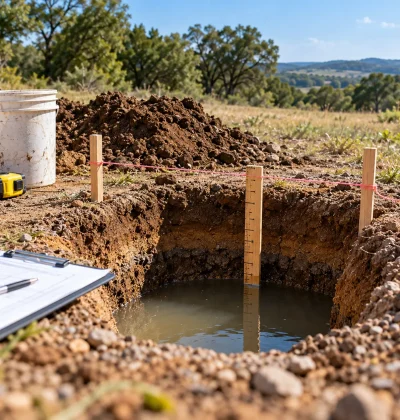
It is a saturation test, not a single pour, and the procedure is written into state code. New Jersey’s rules are among the most explicit: fill the test hole with water and maintain a minimum depth of 12 inches for four hours by refilling as necessary, then stop adding water and allow the hole to drain for 16 to 24 hours.
Only then does measurement begin. The hole is refilled to a depth of seven inches, the time for exactly six inches to seep away is recorded, and that time divided by six is the percolation rate in minutes per inch.
Two things follow for anyone budgeting. The presoak is why this is not a one-hour visit, and the multi-day structure is why scheduling matters more than price in a short due diligence window. Pennsylvania requires six or more test holes across the proposed absorption area, which is why the excavation line is real rather than nominal.
Can land fail because it drains too fast?
Yes, and this is the failure almost nobody expects. Pennsylvania’s absorption area table in 25 Pa. Code 73.16 runs from “Less than 3.0” minutes per inch to “Greater than 181,” and marks the fast end Unsuitable exactly as it marks the slow end Unsuitable.
New Jersey draws the same line from the other direction. Its code states that if any measured rate is faster than three minutes per inch, the application shall not be approved, the same consequence it attaches to any rate slower than 60 minutes per inch. Two states, independently, put the floor at three minutes per inch.
The reason is the mechanism in the previous section. Water racing through coarse sand or gravel does not spend enough time in contact with soil to have pathogens and nutrients stripped out of it, so it arrives at groundwater carrying what the system was built to remove.
So the intuition most buyers arrive with is backwards at one end. Ground that drains instantly after rain and never holds a puddle is not automatically a good septic site. It may be a fast failure.
Why does the same soil pass in one state and fail in another?
Because the threshold is written into state law, and states disagree. New Jersey refuses anything slower than 60 minutes per inch. Pennsylvania permits a standard absorption area out to 181 minutes per inch. A parcel measuring 90 would pass in one and be refused in the other.
That is a threefold disagreement about the same physical measurement, and the best argument against reading national guidance as if it applied to your parcel. Knowing what to look for when buying rural land means knowing which authority sets each rule.
Not every state even has the fast limit. Virginia’s regulations assign estimated percolation rates by soil texture group and restrict soils that impede percolation, without imposing a fast floor at all. The fast-drainage failure is real, it is written into code in multiple states, and it is not universal.
When can the test be done?
In some states, only during a defined season, because the result has to reflect the worst case rather than the driest week of the year. Carroll County, Maryland explains that Maryland regulations require percolation tests be performed at the time of year when the highest water table can be expected, and that this period is generally considered to be February 1 through April 15.
Sit with what that means for a transaction. A buyer who goes under contract in June with a thirty-day due diligence period cannot obtain a compliant test in that county inside that window. The calendar, not the contractor’s schedule, is the binding constraint.
Clay soil is the reason. It behaves acceptably after a dry spell and entirely differently after weeks of rain, and seasonal water table movement of several feet between summer and spring is ordinary. A summer pass on clay can be a spring failure. Ask whether your state restricts testing to a season before you agree a timeline, not after.
What does a failed perc test actually mean?
It means a conventional drainfield is not permitted at that tested location under that state’s standard. It does not mean the parcel cannot be built on, and collapsing those two statements is the most expensive mistake in this subject.
Most states permit alternative and engineered systems for sites that fail the conventional standard, and the trade is cost. Pennsylvania’s own table, for example, treats subsurface sand filters as a separate system class with its own suitability ranges, which is the code’s way of saying a site that fails one design may be permitted under another. Anyone planning to buy land to build a house should price the alternative before assuming the parcel is dead.
What a failure genuinely removes is the cheap option. A conventional gravity drainfield is the least expensive way to handle wastewater on a rural parcel, and the remaining routes cost more to install and usually more to maintain. A failed test converts an unknown into a priced problem, which is the reason to test before closing rather than after.
Who pays for the perc test?
Whoever wants the answer, which in practice means the buyer, because the buyer is the one who cannot close without it. Sellers of untested raw land have little incentive to produce a result that might reduce what the parcel is worth.
That is precisely why the fee belongs in the negotiation rather than beside it. A test the buyer pays for produces information the seller did not have, and a failure discovered during due diligence is a legitimate basis to negotiate land price or to walk, which is the value you are buying for a few hundred dollars.
The cleaner structure on an untested parcel is a contingency: the contract proceeds subject to a satisfactory result, with the testing period sized to the state’s actual requirements rather than to a standard thirty days. Where a testing season applies, that timeline has to respect it.
A parcel that already has a passing result is worth asking two questions about. When was it done, and does the county still honor it, because validity periods are set locally and an old result is not automatically a current one.
Can you screen a parcel before paying for a test?
Partly, and it is free. The USDA Natural Resources Conservation Service publishes soil survey data through Web Soil Survey, which includes a septic tank absorption fields interpretation among its sanitary facilities ratings, so you can see how the mapped soil on a parcel is rated before spending anything.
Treat it as a filter, not an answer. Soil survey mapping is generalized across areas and cannot substitute for a test at a specific location, and no county will accept it in place of one. What it does well is tell you which parcels deserve a test and which deserve a harder look first, the same role every other item on a due diligence checklist plays.
Two other free signals help. Neighboring parcels with occupied houses on septic tell you the area supports systems, and the county health department will usually say on the phone whether records exist for the parcel.
Should a failed perc test kill the deal?
Not automatically. It should change the price, the plan, or both, and which one depends on numbers you can get before you decide. The failure tells you the conventional route is closed, and the next question is what the permitted alternative costs on that specific site.
Run three figures before walking. What an engineered system would cost to install and maintain there, what the parcel is worth with that cost priced in, and what comparable tested parcels are asking. If the seller will absorb the difference, a failed test can end up producing a better purchase than a clean one at full price.
Walk when the alternative system cost approaches a meaningful fraction of the land value, when the county’s standard leaves no permitted design, or when the testing season means you cannot get an answer inside any timeline the seller will accept.
The general rule is unglamorous and it holds. Test before you close, read the result as a two-sided measurement, and check the standard against your own county rather than against anything national, including this page. When you browse land listings the parcels that already carry a passing result and a documented location are worth a premium, because somebody already bought the answer.
Check access and soil flags before you offer
Frequently Asked Questions
How much does a perc test cost?
The county portion is published. Mecklenburg County, North Carolina lists a residential soil test and improvement permit at $250, while Wilson County in the same state charges $400 to $600 scaled by proposed bedrooms. A private soil scientist or engineer and the excavation are quoted separately and vary by market, so check your own county’s fee schedule first.
Can land fail a perc test for draining too fast?
Yes. Pennsylvania marks percolation rates under 3.0 minutes per inch as unsuitable in its absorption area table, and New Jersey refuses any application where a measured rate is faster than three minutes per inch. Water moving through coarse soil too quickly reaches groundwater before the soil has removed pathogens and nutrients, which is what the drainfield exists to do.
Who performs a perc test?
A licensed or certified private evaluator in most states, typically a soil scientist or engineer, with the county health department issuing the permit and in some jurisdictions witnessing or conducting the test. Excavation is usually a separate backhoe operator. Your county health department will name who is authorized locally, since the qualification rules are set at state level.
How long is a perc test good for?
Validity is set locally and varies widely, so an existing result is not automatically current. Some jurisdictions treat approvals as lasting several years, others tie them to the permit rather than to a fixed period, and a change in the proposed house size can require re-evaluation because the fee and the area required both scale with design flow. Confirm with the county.
Does a failed perc test mean you cannot build?
No. It means a conventional gravity drainfield is not permitted at the tested location under that standard. Most states allow engineered or alternative systems on failing sites at higher cost, and other locations on the same parcel may test differently. The failure removes the cheapest option rather than the possibility of building.
Resources and Further Reading
- US EPA, How Septic Systems Work The soil as the treatment step, and what percolating wastewater removes.
- N.J.A.C. 7:9A-6.4, Percolation test (Cornell LII) The full procedure, the presoak, and the fast and slow limits that decide approval.
- 25 Pa. Code 73.16, Absorption and spray field area requirements (Cornell LII) Table A, running from under 3.0 to over 181 minutes per inch with unsuitable marked at both ends.
- Mecklenburg County Public Health, Septic System Fee Schedule Published residential and commercial fees for soil testing and full system permits.
- Wilson County Health Department, Environmental Health Fee Schedule New lot evaluation fees scaled by proposed design flow and bedroom count.
- Carroll County Health Department, Percolation Tests and Wet Weather Testing Maryland’s seasonal testing requirement and the February to April window.